 Hangbo Alloy Group
Forged Discs and Blinds: When Forged Blanks Beat Plate — Grain Flow, UT, RFQ
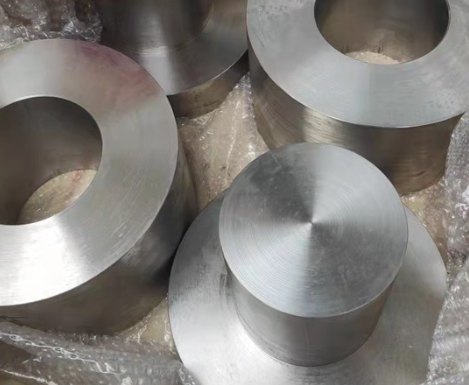
Quick answer: A forged disc — a round, solid blank made by upsetting and piercing a billet — is the right starting point for flanges, retainers, valve bodies and gear blanks whenever the part's strength depends on through-section integrity. Compared with slicing the same shape from plate, a forged disc has a collapsed, uniform grain structure, a verifiable UT-clean core, and no weak through-thickness direction.
What is a forged disc, and how is it made?
A forged disc starts as a round billet, heated and upset (compressed axially) on a press so its diameter grows and the as-cast structure breaks down. Depending on the part, the disc may then be pierced to make a ring, kept solid for a blind flange or retainer, or machined directly. Typical weights run from a few kilograms up to several tonnes; diameters from ~100 mm to 3 m and beyond.
The key metallurgical event is the upsetting deformation itself: it closes porosity from the ingot or bar, refines grains, and aligns them with the disc's working stresses. Plate, by contrast, keeps the directional grain structure it was rolled with — strong in the rolling plane, weaker through thickness.
Forged disc vs plate-machined blank: where the difference shows
| Property | Forged disc | Plate-machined blank |
|---|---|---|
| Grain structure | Uniform, 3-directional | Rolled direction only, weak through-thickness |
| UT inspectability | Sound, clean signal after forging | Lamination risk, ambiguous signals |
| Through-thickness strength | High (no weak axis) | Low — the classic failure plane |
| Large diameters | Available from open-die forging | Limited by plate width |
| Cost at small sizes | Higher | Lower |
| Typical minimum quantity | 1 pc is fine | Any |
For non-critical parts under modest stress, plate blanks are often the economical choice. Forged discs pay for themselves when the part sees pressure, fatigue, impact or load in more than one direction — flange blanks on a pipeline, pump retainers, hydraulic cylinder ends, turbine spacers.
When is a forged disc mandatory rather than optional?
- Pressure-retaining parts — code flange blanks and blinds where the applicable code expects forged material (e.g. ASTM A182).
- Fatigue-loaded parts — anything that cycles: compressor discs, gear blanks, couplings.
- Thick sections — plate above ~100 mm has limited availability and pronounced directionality.
- Parts requiring 100% UT — forged material gives clean, interpretable ultrasonic signals; plate laminations generate false rejects.
What inspection should come with forged discs?
- UT per ASTM A388 on discs above roughly 100 mm thickness, with acceptance class agreed in advance.
- Heat treatment certificates — normalizing, quench-and-temper or solution treatment as the grade requires, with actual hold times and temperatures.
- Mechanical tests on prolongation — a test ring or bar forged with the disc, heat-treated with it, and tested so the results represent the part.
- MTR with heat number traceability, matching the standard called out (A182 for stainless flange grades, B637 for nickel superalloys, and so on).
How to order: the five-line disc RFQ
- Material grade + standard (e.g. 316/316L per ASTM A182 F316/F316L).
- Diameter × thickness, machined or as-forged, with tolerance expectations.
- Quantity and delivery condition (heat treatment state, machined allowance).
- Inspection: UT class, mechanical tests on prolongation, certificates required.
- End use in one line — "RFQ: valve retainer, 40 bar, 150 °C" gets a better-engineered offer than a bare dimension list.
FAQ
Q: Can a forged disc be made with a hole already in it? A: Yes — pierced and expanded, it becomes a rolled ring. If the ID is substantial relative to OD, a seamless rolled ring is usually more economical than machining a hole from a solid disc.
Q: Is a forged disc stronger than the same grade in plate? A: Not a different strength number after heat treatment — the advantage is directionality and soundness. Forged material has no weak through-thickness axis and a defect-free core, which matters for fatigue and pressure.
Q: How much machining allowance should I expect on an as-forged disc? A: Typically 3–10 mm per side depending on size, plus distortion allowance for heat treatment. Specify the finished dimensions and let the forger set the blank size.
Q: What is the smallest quantity a forge shop will take? A: One piece is normal for open-die work — you pay for the heat and setup, so unit cost at quantity 1 is high but the option exists, which is exactly what makes forgings useful for repairs and prototypes.
Shanghai Hangbo Alloy Group
🌐 Website: www.hangbo-metal.com
📧 Email: Craliey1382@gmail.com
💬 WhatsApp: +86 19169850074
📞 Tel: +86 19169850074
📍 Address: No. 388 Songhuang Rd, Qingpu District, Shanghai, China
👤 Contact Person: Tiffany Luo