 Hangbo Alloy Group
Forged Stainless Steel Discs and Blocks: ASTM A182, Forging Process and UT Testing
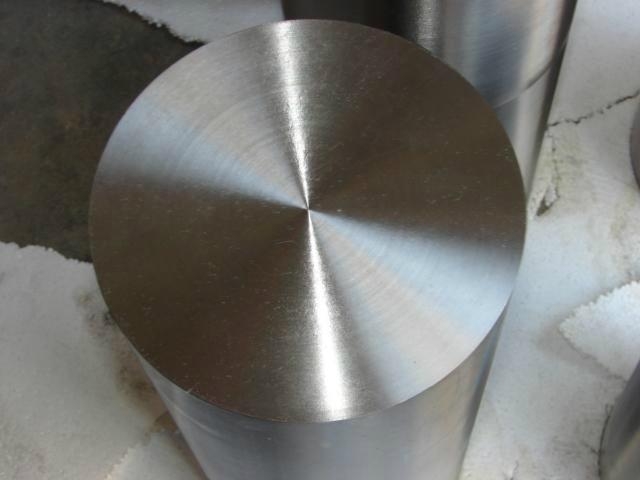
When a part is too large, too highly loaded, or too critical for a rolled product, it gets forged. Forged stainless steel discs, blocks and stepped shafts are the starting point for flanges, pressure vessel heads, turbine components, valve bodies and heavy machinery pins — anywhere the metal's internal soundness and grain structure decide whether the part survives.
This guide explains how forged discs and blocks are produced, why the forging route improves the metal, which standards apply (ASTM A182, A965, EN 10222), what testing to require, and how to buy forgings that pass your inspection the first time.
Why Forging Beats Casting (and Machining from Plate)
Forging plastically deforms the metal at hot working temperature, which:
- Closes porosity and shrinkage inherited from the ingot or billet
- Breaks up and refines the as-cast grain structure, producing fine, uniform grains
- Aligns the grain flow with the part's shape, improving toughness and fatigue life in the loaded direction
- Delivers full-density material with no internal voids — verifiable by ultrasonic testing
Compared with machining a disc out of thick plate, forging gives isotropic properties (no weak through-thickness direction) and dramatically better impact toughness at low temperature.
The Production Route
- Melting & ingot/billet casting — AOD or EAF melting; ESR (electroslag remelting) for premium cleanliness
- Heating — typically 1150–1200°C for austenitic grades, controlled to avoid grain growth
- Forging — hydraulic press or hammer: upsetting, drawing out, ring rolling, or open-die block forging. Multiple passes with rotation produce the circular flow lines visible on a forged disc face
- Solution annealing — typically 1040–1100°C then rapid water quench to restore corrosion resistance
- Machining — peeling/turning to the delivered size with machining allowance
- Testing — UT, mechanical, intergranular corrosion as ordered
Applicable Standards
| Standard | Scope |
|---|---|
| ASTM A182/A182M | Forged or rolled pipe flanges, forged fittings, valves and parts — the classic flange/fitting forging spec |
| ASTM A965 | Steel forgings, ferritic/austenitic, for pressure vessels |
| ASTM B462 | Forged nickel alloy (904L, 825, C276…) flanges and parts |
| EN 10222-2…5 | European pressure-use forgings |
| ASME SA-182 | ASME code version of A182 for boilers and pressure vessels |
For non-flange discs and blocks, A182 grades are still commonly referenced with a supplementary UT acceptance level agreed in the order.
Common Grades for Forged Discs and Blocks
| Grade | UNS | Forged part examples |
|---|---|---|
| 304/304L (F304) | S30403 | General flanges, Blind flanges, vessel components |
| 316/316L (F316) | S31603 | Chemical and marine flanges, valve bodies |
| 321 / 347 | S32100 / S34700 | Thermally cycled parts, furnace fittings |
| Duplex 2205 (F60) | S32205 | Offshore flanges, high-strength hubs |
| Super Duplex 2507 (F53) | S32750 | Seawater and desalination components |
| 17-4 PH | S17400 | High-strength shafts, actuators, tooling |
| 904L / Alloy 825 / C276 | N08904 / N08825 / N10276 | Acid service, sour gas, flue gas desulfurization |
Testing You Should Require
For critical forgings, specify:
- Ultrasonic testing (UT) to ASTM A388 straight-beam, with acceptance level stated (e.g., 1.5 mm flat-bottom-hole equivalent) — this is the core soundness proof
- Mechanical tests per heat: tensile, yield, elongation, hardness; impact (Charpy) for low-temperature service
- Intergranular corrosion test (ASTM A262 Practice E) for sensitization-prone service
- Grain size (ASTM E112) where fatigue life matters
- EN 10204 3.1 certificate as minimum; 3.2 third-party witnessed (TUV/BV/SGS/Lloyd's) for offshore and code work
- Heat number and UT map supplied with the documentation package
How to Specify a Forging (Buyer's Checklist)
- Shape: disc, block, ring, stepped shaft, or near-net forging — attach a drawing with tolerances
- Grade + UNS, melted by AOD/ESR if cleanliness matters
- Delivered size with machining allowance direction (OD +, thickness +)
- Standard: A182 / A965 / EN 10222, plus ASME code requirement if applicable
- Heat treatment condition: solution annealed, quenched, aged (for PH grades)
- Tests: UT class, mechanicals, corrosion tests, grain size
- Certification level: 3.1 or 3.2, and any customer witness points
Cost tip: forgings are priced by mass + complexity + testing. Delivering as a disc "as-forged +1 machining allowance" instead of fully machined can cut 20–40% off the piece price when you have machining capacity in-house.
Frequently Asked Questions
What is the largest forging you can supply? Typical open-die capacity reaches discs and blocks in the multi-ton range (e.g., discs to Ø2000+ mm, blocks in metric tons) depending on grade — send your drawing for confirmation.
Is there a minimum order quantity? Forgings are made per piece, not per lot. You can order one piece; the price per kilogram improves with size of the production heat.
How long does a custom forging take? Common grades from stocked billet: 3–6 weeks including heat treatment and testing. ESR-melted or nickel-alloy forgings: 8–12 weeks.
Can you supply forgings with third-party inspection? Yes — 3.2 certification with TUV, BV, SGS or classification societies (DNV, Lloyd's, ABS) witnessed at the forge, and full documentation packages for code work.
Get a Quote for Forged Discs and Blocks
Shanghai Hangbo Alloy Group manufactures and supplies forged discs, blocks, rings and shafts in 304/316L, 321/347, duplex 2205/2507, 17-4 PH, 904L and nickel alloys to ASTM A182/A965/B462 and EN 10222, with UT per A388 and EN 10204 3.1/3.2 certification. Send your drawing, grade and quantity — our engineers reply with weight calculation, price and delivery within 24 hours.
Shanghai Hangbo Alloy Group
🌐 Website: www.hangbo-metal.com
📧 Email: Craliey1382@gmail.com
💬 WhatsApp: +86 19169850074
📞 Tel: +86 19169850074
📍 Address: No. 388 Songhuang Rd, Qingpu District, Shanghai, China
👤 Contact Person: Tiffany Luo