 Hangbo Alloy Group
Inconel 718 Heat Treatment Explained: Solution Annealing, Double Aging and AMS 5662
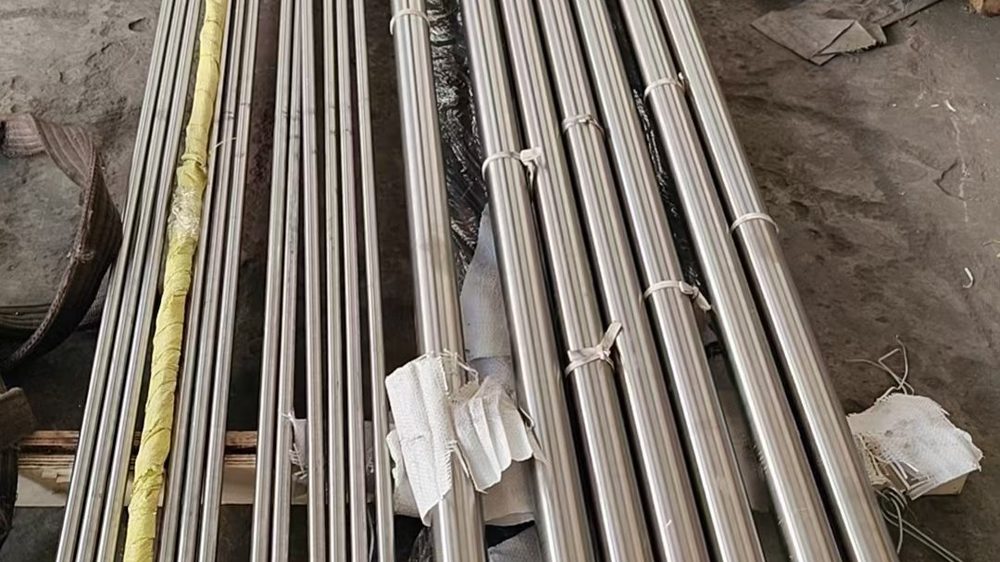
Inconel 718 Heat Treatment Explained: Solution Annealing, Double Aging and AMS 5662 vs GB/T 14993

Quick answer: Inconel 718 (UNS N07718, Chinese equivalent GH4169) gets its strength from precipitation hardening, not from quenching. The standard cycle is: solution treat 940–980°C/1 h, air cool or water quench — then double age: 720°C/8 h, furnace cool at ~55°C/h to 620°C, hold 8 h, air cool (the "720+620" cycle per AMS 5662). This yields a yield strength above 1,030 MPa at room temperature that increases up to ~650°C. Per AMS 5662 the stock condition is solution + double aged; per AMS 5663 (sheet) it is solution treated + aged. Skipping or under-aging the second step can cut yield strength by 200–300 MPa.
718 is the most-specified superalloy in the world — and also the one most often heat treated wrong by workshops that treat it like stainless steel. This guide explains why the cycle looks the way it does, what each stage does metallurgically, and how to check a supplier's certificate against the standards.
1. Why 718 Needs a Special Cycle: The γ″ Phase
718's strength comes from a fine dispersion of γ″ (Ni₃Nb, body-centered tetragonal) plus some γ′ (Ni₃AlTi) precipitates:
- γ″ nucleates between 600–760°C, peaks in hardness around 720°C
- γ″ is metastable: above ~650°C service it slowly transforms to the equilibrium δ (Ni₃Nb orthorhombic) phase, losing coherency and strength
- The double age (720°C then 620°C) grows two precipitate size populations, maximizing strength while the final 620°C leg stabilizes the structure
This is why the aging temperature window is tight: ±10°C matters. A furnace drifting to 745°C over-ages γ″; one running 700°C under-precipitates. Both show up as failed tensile results.
2. The Standard Cycles, Side by Side
| Step | Bar/forging (AMS 5662 / GB/T 14993) | Sheet (AMS 5663) |
|---|---|---|
| Solution | 940–980°C / 1 h / AC or WQ | 940–980°C / AC |
| 1st age | 720°C / 8 h / FC @ ~55°C/h | 720°C / 8 h / FC |
| 2nd age | to 620°C / 8 h / AC | to 620°C / 8 h / AC |
| Resulting condition | "720+620 double aged" | solution treated + aged |
Variants you will encounter:
- Homogenization (ingot stage): 1,090–1,120°C, long hold — done by the melt shop, not visible on your bar MTR except as "homogenized"
- Direct aging (DA) / 648–677°C single age: used for large forgings (e.g. aircraft engine disks per some OEM specs) where re-solution treating would crack or distort; lower ductility, better notch toughness balance
- High-strength cycle: 955–980°C solution + 720/620 double age — the standard route
- Annealed-only condition: sometimes sold as "718 annealed" for machining-blank buyers; ~40% weaker than aged — fine for machining, not for service
3. Mechanical Properties You Should See on the MTR
Room temperature, per AMS 5662 (bar/forging, solution + double aged):
| Property | Spec minimum | Typical production value |
|---|---|---|
| Tensile strength | 1,275 MPa | 1,350–1,450 MPa |
| 0.2% Yield strength | 1,035 MPa | 1,100–1,250 MPa |
| Elongation | 12% | 15–20% |
| Reduction of area | 15% | 25–35% |
| Hardness | ≥ 331 HB | 360–420 HB |
And the reason 718 dominates: yield strength at 650°C is still ~1,000 MPa — no other wrought alloy in its price class holds that. (For the chemistry and equivalences, see our GH4169 vs Inconel 718 grade guide.)
4. Heat Treatment Defects and What Causes Them
| Symptom on test report | Likely cause | Fix |
|---|---|---|
| Yield low, tensile OK, elongation high | Under-aged (temp low or time short) | Re-age full 720/620 cycle |
| Yield AND ductility low | Over-aged (>740°C) or δ formed at solution temp too low | Re-solution treat at proper range, re-age |
| Notch brittleness | Contamination (S, Pb) or coarse grain from overheating | Check furnace atmosphere; re-solution treat |
| Cracks during aging of big section | Aging a cold, welded, or as-welded repair | Age from preheat; follow weld-repair cycles |
| Property scatter across a bar | Furnace non-uniformity (>±8°C zone spread) | Calibrated, surveyed furnace per AMS 2750 |
Procurement tip: ask suppliers whether their aging furnace has a thermocouple survey (AMS 2750 pyrometry). It is the single best predictor of lot-to-lot consistency in 718.
5. Machining Sequence — Where Most Shops Go Wrong
- Rough machine in solution-treated (or aged) condition, leave 1–2 mm finish stock
- Age (720/620) — expect ~0.05–0.10% dimensional growth; rough-machined parts must have allowance for it
- Finish machine / grind after aging
- Avoid final machining at surface speeds that overheat: 718 work-hardens and a burned skin becomes a fatigue crack initiation site
Ordering pre-aged bar for immediate machining? Tell us the final condition you need — we supply Inconel 718 bar and forgings in solution-treated, direct-aged and full double-aged conditions with corresponding MTRs.
Frequently Asked Questions
Q: Can I heat treat 718 in a normal air furnace? Yes for bar and open parts — the thin oxide is removed in finishing. For parts with tight surfaces or thin walls use vacuum or argon to avoid α-case-like depletion; scale removal by acid etch afterward.
Q: What is the difference between AMS 5662 and AMS 5663? Both cover N07718 bar/forgings vs sheet, and the key practical difference is the supplied condition: 5662 = solution + double aged; 5663 = solution treated + aged with slightly different property floors. Always cite the right spec in your PO.
Q: Does welding destroy the aging treatment? Welding re-solution-treats the fusion zone locally and over-ages the adjacent HAZ. Standard practice: weld in solution-treated condition, then perform the full double age after welding. Aged-then-welded parts without re-aging fail prematurely.
Q: Is GH4169 heat treated the same as Inconel 718? Yes — GB/T 14993 specifies the equivalent 720+620 double aging. Differences are administrative (testing frequency, sampling), not metallurgical.
Q: Why did my 718 part grow after aging? Precipitation of γ″ causes a slight volumetric expansion, typically 0.05–0.1% linear. It is predictable and is the reason for the "rough machine → age → finish" sequence above.
Shanghai Hangbo Alloy Group
🌐 Website: www.hangbo-metal.com
📧 Email: Craliey1382@gmail.com
💬 WhatsApp: +86 19169850074
📞 Tel: +86 19169850074
📍 Address: No. 388 Songhuang Rd, Qingpu District, Shanghai, China
👤 Contact Person: Tiffany Luo