 Hangbo Alloy Group
Stainless Steel Circles: Blanks for Spinning, Drawing and Tank Heads — How to Buy
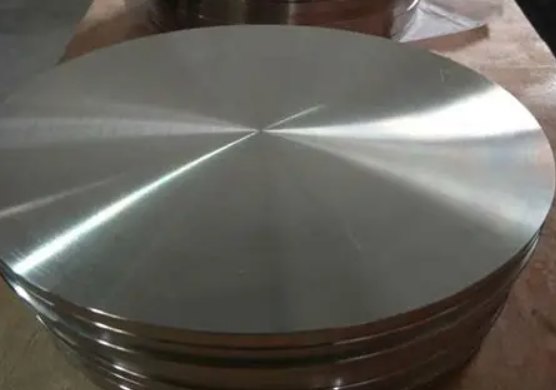
Quick answer: A stainless steel circle — a flat, round blank cut from sheet or plate — is the starting point for anything spun, drawn or deep-drawn: cookware, pressure-vessel heads, tank bottoms, lamp reflectors and fan housings. Buying circles instead of cutting your own from square plate saves material (no corner scrap), saves a cutting pass, and gives a cleaner edge for spinning and drawing.
What exactly is a "circle" in the metals trade?
Circles (also called discs, blanks or round plate) are sheared, plasma- or laser-cut round blanks supplied in a diameter and thickness you specify. They sit between sheet and forging in the supply chain: too big or thick for a standard sheet program, not requiring the grain control of a forging. Typical range runs from ~100 mm to 2.5 m diameter and from 1 mm to 50+ mm thick.
Who buys circles and why?
| End use | Typical thickness | Why a circle beats square plate |
|---|---|---|
| Cookware, kettles, sinks | 0.8–3 mm | Zero corner scrap; clean edge for spinning |
| Pressure vessel heads (pre-form) | 6–25 mm | Ready for dishing/pressing without re-cutting |
| Tank bottoms and blind ends | 4–12 mm | One-piece, no weld seam in the flat |
| Fan housings, Covers, flanges | 3–10 mm | Nesting efficiency at the fabricator |
| Reflectors, decorative discs | 0.8–2 mm | Full surface finish available on the finished face |
The economics are simple: corners of a square plate are pure waste when the part is round. A service center cutting circles from wide coil or plate can nest them tightly and pass the saving on.
Surface finish: the spec that matters most on circles
For spun and drawn parts, the finish of the face that becomes the outside of the product is critical — scratches show through after spinning and polishing cannot always remove deep ones:
- 2B — standard mill finish, the most economical for parts that will be polished after forming.
- BA / bright-annealed — for parts used as-delivered with a bright look.
- No. 4 / brushed — decorative products, specified with grain direction if relevant.
- Mirror / No. 8 — reflectors and high-end cookware; always order protective film on this face.
For thick circles destined for heads and tanks, surface matters less than thickness tolerance and UT soundness — a lamination inside a dished head blank is an expensive discovery.
Grades and standards
Circles are cut from the same sheet and plate standards: ASTM A240 for 304/304L, 316/316L and most austenitic grades, with duplex and nickel alloys available on request. Grade selection follows the end product's corrosion needs — 304 for indoor cookware, 316L for chemical and marine products, as covered in the 304L vs 316L guide.
What should a circle RFQ include?
- Diameter and thickness, with the tolerance you need (standard sheared tolerance vs machined OD for spinning mandrels).
- Grade, standard and finish — including which face carries the finish.
- Edge condition: sheared, plasma, laser or machined — spinning shops often want a clean machined edge to avoid edge cracking.
- Quantity and nesting — a mixed-diameter order nested from the same plate is cheaper than separate plates per size.
- End use — "for deep drawing sinks" tells the supplier which forming-quality (forming ratio, anisotropy) matters.
FAQ
Q: Can circles be supplied with a slightly thicker rim for spinning? A: No — thickness is uniform across the blank. What spun products sometimes need is a harder or softer temper; that is controlled by the mill anneal, not by geometry.
Q: Why did my circles crack at the edge during deep drawing? A: Most often a sheared edge with micro-cracks, wrong temper (too hard), or drawing ratio beyond the grade's limit. Specify a machined or deburred edge and forming-quality (DDQ) material for deep draws.
Q: What is the largest circle available from stock? A: From wide plate, diameters to 2.5 m and beyond are cut to order; beyond that the part moves into forged disc territory, where the grain structure is superior for pressure service.
Q: Are circles cheaper per kg than plate? A: Usually similar per kg but cheaper per part, because you pay only for the round, not the corners — and you skip your own cutting operation entirely.
Shanghai Hangbo Alloy Group
🌐 Website: www.hangbo-metal.com
📧 Email: Craliey1382@gmail.com
💬 WhatsApp: +86 19169850074
📞 Tel: +86 19169850074
📍 Address: No. 388 Songhuang Rd, Qingpu District, Shanghai, China
👤 Contact Person: Tiffany Luo