 Hangbo Alloy Group
Stainless Steel Round Bar: Grades, ASTM A276 & Tolerances
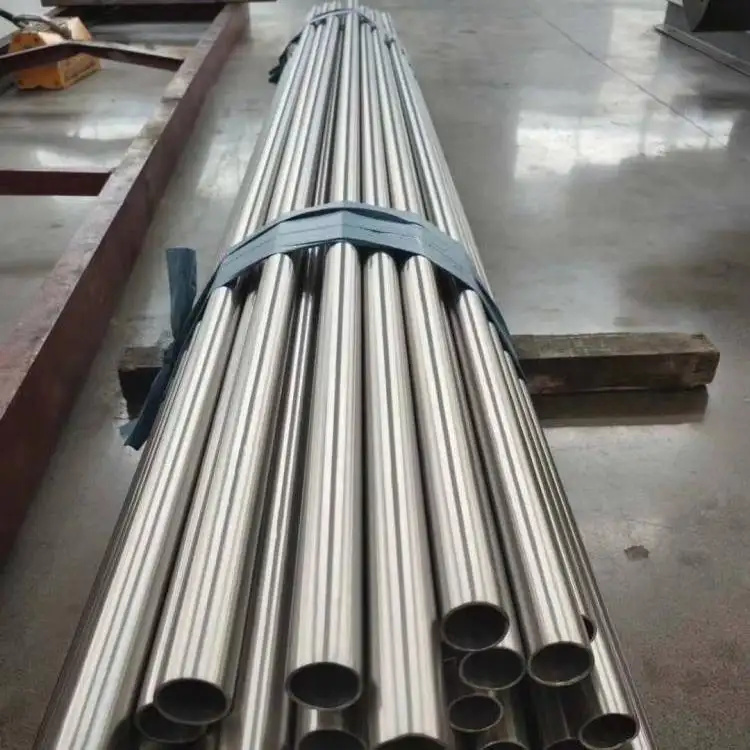
Stainless steel round bar is a solid cylindrical bar produced by hot rolling, forging or peeling, supplied to standards such as ASTM A276 and A479, and used primarily for shafts, fasteners, valves, pump components and machined parts. It is one of the highest-volume product forms in stainless distribution — and one where choosing the wrong grade or tolerance condition quietly costs manufacturers the most.
This guide covers the grades that matter, the standards to specify, and the tolerance conditions (hot rolled vs. peeled vs. polished) that determine how much machining you'll pay for downstream.
On this page: 1. Production Conditions: Why "Bar" Isn't Just "Bar" 2. Grades We Supply — and What Each Is For 3. Standards to Put in Your RFQ 4. Matching Bar Grade to Application 5. Quality Checks That Matter for Bar 6. Frequently Asked Questions 7. Order from Stock
1. Production Conditions: Why "Bar" Isn't Just "Bar"
| Condition | Process | Diameter Tolerance | Best For |
|---|---|---|---|
| Hot rolled (HR) | Rolled at high temp, descaled | Wide (±1–2%) | Forging stock, welding, structural |
| Peeled / Turned | HR bar machined to size | h9–h11 | CNC machining, shafts |
| Ground & Polished | Peeled then centerless ground | h7–h9 | Precision shafts, visible parts |
| Forged | Open-die forged + annealed | Per agreement | Large diameters, 200 mm+ |
The tolerance class you order directly drives your machining cost: specifying peeled (h9) bar instead of hot rolled can remove an entire turning operation from your process.
2. Grades We Supply — and What Each Is For
| Grade | UNS | Min Tensile | Standout Property | Typical Parts |
|---|---|---|---|---|
| 304 / 304L | S30400 | 515 MPa | All-round, cost-effective | Fasteners, general machining |
| 316L | S31603 | 485 MPa | 2–3% Mo, chloride resistant | Pump shafts, marine fittings |
| 321 | S32100 | 515 MPa | Ti-stabilized, weld-safe | Exhaust & heat-exchanger components |
| 310S | S31008 | 515 MPa | Heat resistant to ~1,050 °C | Furnace rollers, fixtures |
| 2205 | S32205 | 620 MPa | Duplex — 2× yield of 304 | High-pressure shafts, couplings |
| 254SMO | S31254 | 650 MPa | 6% Mo, seawater-proof | Offshore & desalination parts |
| 17-4PH | S17400 | 1,310 MPa (H900) | Age-hardened to HRC 38–43 | Aerospace fasteners, valve stems |
3. Standards to Put in Your RFQ
- ASTM A276 – the general standard for stainless bar and shapes
- ASTM A479 – bar for pressure-vessel and boiler use (adds toughness requirements)
- AMS 5643 – 17-4PH for aerospace applications
- GB/T 1220 – Chinese stainless bar standard
A complete specification looks like: "316L round bar, 80 mm dia., peeled, ASTM A276 condition A, with EN 10204 3.1 certificate." That last clause — the certificate level — is what separates industrial-grade suppliers from traders.
4. Matching Bar Grade to Application
Pump and mixer shafts → 316L or 2205. Shafts see combined bending stress and corrosive media. Duplex 2205 gives twice the yield (450 vs 205 MPa minimum), allowing smaller diameters and less deflection.
Valve stems and high-strength fasteners → 17-4PH. Solution-treated, it machines like free-cutting steel; after H900 aging it reaches ≥1,310 MPa tensile and HRC 38–43 — triple the strength of 316L with better galling resistance.
Furnace and heat-treat fixtures → 310S. Oxidation resistance up to ~1,050 °C in continuous service, with stable scaling behavior through repeated thermal cycles.
Machined commercial parts → 304. When the part never sees chlorides or heat, 304 is the rational default — don't pay for alloying you don't need.
5. Quality Checks That Matter for Bar
- Chemistry verification — spectrometric analysis per heat (beware "304" bar that tests as 201)
- Tensile + hardness — per A276 condition requirements
- IGC test (ASTM A262) — for welded or sensitization-prone service
- NDT — ultrasonic testing to SEP 1921 / NAS 403 class for shaft-grade bar
- Traceability — heat number stamped and traceable from melt to delivery
Shanghai Hangbo Alloy Group ships every bar order with CNAS / CMA / SGS accredited bilingual (EN/CN) test reports, and full melt-number traceability under its AS9100D and ISO 9001 quality systems.
6. Frequently Asked Questions
What is the difference between ASTM A276 and A479 bar?
A276 is the general-purpose stainless bar standard; A479 adds requirements for pressure-vessel and boiler service. If your bar goes into an ASME-code item, specify A479.
Which diameter tolerances can stainless round bar be supplied to?
Hot rolled bar carries wide rolling tolerances; peeled bar is machined to h9–h11; ground and polished bar reaches h7–h9. Specify the condition, not just the diameter, when bars feed directly into CNC machining.
Is 17-4PH stronger than 316L?
Dramatically — in the H900 condition 17-4PH reaches ≥1,310 MPa tensile versus 485 MPa for 316L, roughly 2.7× stronger, though with lower corrosion resistance and elongation.
What's the largest diameter available?
Rolled and peeled bar typically covers 6–200 mm; forged and machined bar can be produced well beyond that per agreement, including blocks and stepped shafts.
7. Order from Stock, Not from a Trading Company
Shanghai Hangbo Alloy Group stocks stainless and nickel-alloy round bar from 304 to 17-4PH and Inconel 718, offers cutting, peeling, heat treatment and forging in-house, and exports worldwide with third-party certification — supported by offices in Shanghai, Düsseldorf and Houston.
Shanghai Hangbo Alloy Group
🌐 Website: www.hangbo-metal.com
📧 Email: Craliey1382@gmail.com
💬 WhatsApp: +86 19169850074
📞 Tel: +86 19169850074
📍 Address: No. 388 Songhuang Rd, Qingpu District, Shanghai, China
👤 Contact Person: Tiffany Luo