 Hangbo Alloy Group
Welding Stainless to Carbon Steel: Why ER309L Works and How to Buy Filler Wire
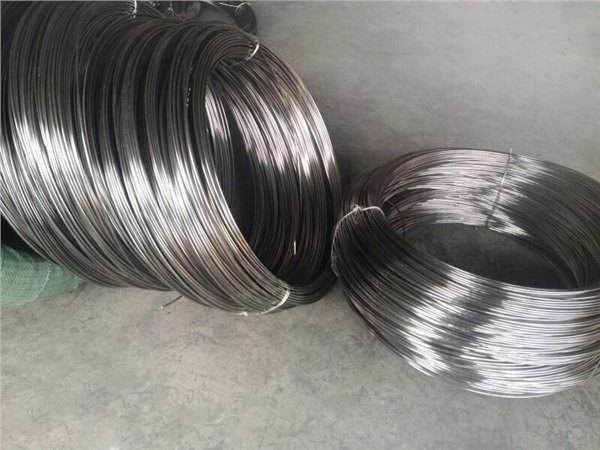
Quick answer: For welding stainless to carbon steel — or anything dissimilar — ER309/309L is the default filler: its high chromium and nickel content (23 Cr / 13 Ni) dilutes safely when mixed with mild steel, without forming brittle martensite. For stainless-to-stainless, match the filler to the lower-alloy side (ER308L for 304L, ER316L for 316L). Everything else — MIG vs TIG, wire diameter, gas mix — is convenience, not chemistry.
Why dissimilar joints need a special filler
When stainless and carbon steel melt together in the weld pool, the carbon steel dilutes the alloy content. If you fill that joint with ER308L, the diluted pool can drop below the threshold where austenite can absorb all the carbon — the result is hard, crack-sensitive martensite in the weld. ER309L starts with so much extra chromium and nickel that even after dilution the pool stays fully austenitic or austenite-ferrite, and the joint stays ductile.
| Joint type | Filler choice | Why |
|---|---|---|
| 304L / 304 → carbon steel | ER309L | Dilution-safe chemistry |
| 316L → carbon steel | ER309L | Same reason; corrosion handled by the stainless side |
| 304L → 304L | ER308L | Standard match |
| 316L → 316L | ER316L | Moly retained for corrosion |
| 321/347 → anything stainless | ER347 | Ti/Nb-stabilized, resists intergranular attack |
How is welding wire actually supplied?
Stainless filler wire reaches the end user in three physical forms, and choosing the right one is as practical as choosing the grade:
- TIG rods — straight lengths, typically 1.0–3.2 mm diameter, 1 m long, in 5–10 kg boxes.
- MIG spools — 0.8/0.9/1.2 mm wire on 5, 15 or 250 kg spools, wound to feed smoothly.
- Submerged-arc and flux-cored variants — for heavy plate and production welding.
Feeding quality matters more than buyers expect: cast and helix (how straight the wire comes off the spool), consistent diameter, and a clean, soap-free surface are what stop bird-nesting in the liner.
What about the wire's own quality certificates?
A proper MTR for filler wire shows chemistry per heat, and the grade designations follow AWS A5.9 (ER308L, ER309L, ER316L...). Three checks catch most real-world problems:
- Chemistry vs grade limits — especially the low end: a "308L" with 19.5% Cr instead of 20% minimum is off-spec.
- Ferrite content — for weldability, 3–10 FN is the usual target; fully austenitic wire is prone to hot cracking.
- Surface and diameter — measure a few points; sloppy diameter control is the leading cause of feed problems on site.
What should a filler-wire RFQ say?
- Grade + AWS class (e.g. ER309L per AWS A5.9).
- Form and size — TIG rod 2.4 mm × 1000 mm, or MIG 1.2 mm on 15 kg spool.
- Quantity and packing — boxes sealed in plastic; humidity ruins the surface finish over long storage.
- Certificates — MTR per heat; optionally ferrite number report.
- End use in one line — "welding 316L pipe to A106" is enough for the supplier to sanity-check the choice.
FAQ
Q: Can I use ER309L for everything just to keep one spool on the rack? A: Many shops do, and for structural work it is acceptable. But on pure stainless-to-stainless corrosion service, the matched filler (316L with 316L) preserves molybdenum and chloride performance — 309L is the universal fallback, not the corrosion optimum.
Q: Why did my 309L weld crack? A: Most often it is not the wire: fully austenitic chemistry from wrong dilution control, high restraint, or sulfur contamination from free-machining grades are the usual causes. Check the base materials and joint restraint before blaming the filler.
Q: Does stainless MIG wire need different gas than mild steel? A: Yes — 98% Ar / 2% CO2 (or 1–2% O2 mixes) is standard for spray transfer on stainless. The 75/25 mix used on mild steel gives a sluggish, sooty stainless weld.
Q: How should wire be stored? A: Sealed in original plastic, off the floor, and used FIFO. Stainless wire does not rust the way carbon wire does, but surface staining causes porosity and feeding friction.
Shanghai Hangbo Alloy Group
🌐 Website: www.hangbo-metal.com
📧 Email: Craliey1382@gmail.com
💬 WhatsApp: +86 19169850074
📞 Tel: +86 19169850074
📍 Address: No. 388 Songhuang Rd, Qingpu District, Shanghai, China
👤 Contact Person: Tiffany Luo