 Hangbo Alloy Group
Heavy-Wall Cylinder Sleeves: Seamless Tube vs Forged-and-Bored vs Centrifugal Casting
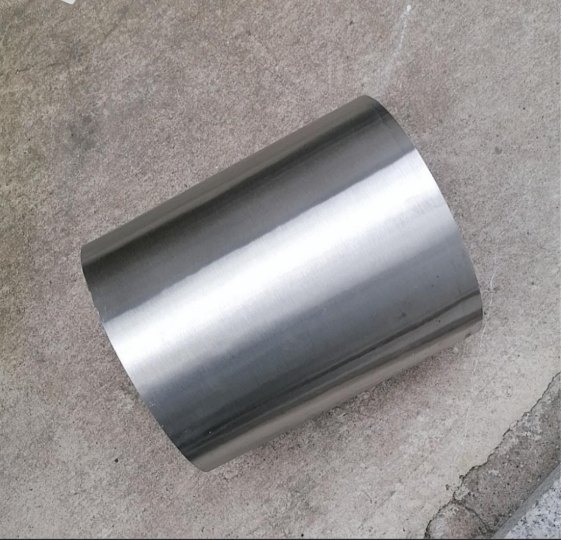
Quick answer: For heavy-wall cylinders (sleeves, boring blanks, wear rings, cylinder liners), the sourcing choice is seamless tube (cheapest, limited sizes), forged-and-bored (strongest grain, any size, most machining), or centrifugal casting (near-net ID, large diameters, porosity risk to manage). Under roughly OD 400 mm, seamless tube usually wins; above it, compare forging against centrifugal casting on price and inspection requirements.
What Are the Three Routes to a Heavy-Wall Cylinder?
| Route | Typical size window | Grain structure | Wall/ID accuracy | Relative cost |
|---|---|---|---|---|
| Seamless tube (ASTM A312 / A269 etc.) | OD up to ~400–500 mm, wall to ~50 mm | Fibrous, worked | Excellent ID/OD concentricity from mill | 1.0 |
| Forged & bored (solid forge, trepanned/bored) | Any OD, wall 50–250 mm+ | Dense, forged flow, best UT response | ID and finish all yours to machine | 1.3–2.0 |
| Centrifugal casting | OD 150–2,000 mm+, wall 20–150 mm | Equiaxed, sound but possible porosity | Near-net bore, less machining | 1.1–1.6 |
When Does Seamless Tube Stop Making Sense?
Above about OD 400 mm the tube mill size list thins out fast and price per kg climbs. Two thresholds to watch:
- Wall ratio: when wall exceeds ~10–12 % of OD, tube deformation (ovality) and finish-machining stock start eating the price advantage.
- Specification: if the drawing calls for UT per forged standards or grain-flow requirements, tube may simply not qualify — see forged hollow cylinders and bored forgings for when the spec forces forging.
When Is Centrifugal Casting the Smart Pick?
Centrifugal casting spins molten metal in a rotating mold, so the bore forms near-net — you machine only a skin. It shines for:
- Large-diameter, medium-wall sleeves (OD 500–1,500 mm) where forging a solid and trepanning would waste enormous material
- Rollers, cylinder liners, wear rings in series production
- Grades that cast well (many stainless and nickel grades do)
The trade-off: cast structures can carry shrinkage porosity or inclusions, so specify UT acceptance (e.g. per ASTM A423-class criteria or customer spec) and buy from suppliers who X-ray or UT every casting. For fatigue-critical or pressure-boundary parts, most buyers still prefer forged rings and cylinders.
What Should the RFQ State So Quotes Are Comparable?
- Finished OD × ID × length plus machining stock assumption
- Route preference or acceptance route: "tube permitted if it meets UT" saves money; "forging only" if spec demands
- Material spec with UNS (e.g. 316L/S31603, 4140, Inconel 625)
- UT requirement: acceptance class, 100 % or prolongation
- Heat treatment condition required at delivery (quenched & tempered, solution annealed)
- Quantity — route economics shift completely between 1 piece and 50
FAQ
Q: Is a centrifugal casting as strong as a forging? A: Tensile can be similar after heat treatment, but castings have lower ductility and fatigue scatter unless heavily inspected. For rotating or pressure-cycling parts, forgings remain the engineering default; for static wear sleeves, castings are cost-effective.
Q: Can you bore a cylinder from solid bar instead? A: Yes — that is the forged-and-bored route when starting from a forged billet. Boring from rolled bar works for small sleeves but the central portion of large bar is where segregation and porosity hide, which is exactly what trepanning removes in a proper forging.
Q: Which route for a one-off 600 mm OD sleeve in 316L? A: Get both prices: centrifugal casting (near-net bore, less machine time) vs forged-and-bored (denser, full UT confidence). At one piece, machine time dominates — casting often wins; at ten pieces, forging amortizes better.
Shanghai Hangbo Alloy Group
🌐 Website: www.hangbo-metal.com
📧 Email: Craliey1382@gmail.com
💬 WhatsApp: +86 19169850074
📞 Tel: +86 19169850074
📍 Address: No. 388 Songhuang Rd, Qingpu District, Shanghai, China
👤 Contact Person: Tiffany Luo