 Hangbo Alloy Group
Seamless Rolled Rings: How Ring Rolling Works and When to Specify Them
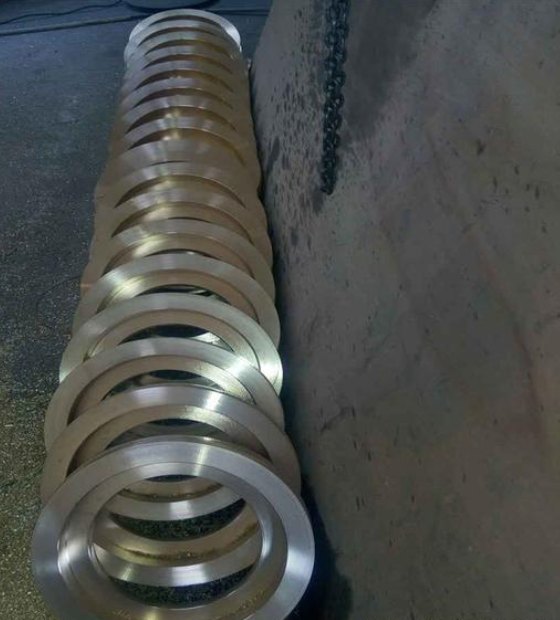
Seamless Rolled Rings: How Ring Rolling Works and When to Specify Them
Quick answer: A seamless rolled ring starts as a punched, forged "donut" that is rolled to final diameter, so the metal's grain flow follows the ring's contour. That gives better fatigue life, toughness and pressure integrity than a ring machined from plate, usually at lower cost once diameters exceed a few hundred millimetres. Specify OD × ID × height, material and standard, heat-treat condition, machining allowance, UT level and certification — those six items decide price and performance.
Flanges, bearing races, pressure vessel shells, valve bodies, gearbox hubs — behind nearly every reliable welded or bolted ring-shaped part is a forging decision someone made at RFQ stage. Choose the wrong ring route and the part may pass inspection yet fail in fatigue; choose it well and you save both weight and machining cost. Here is the honest comparison.
How Ring Rolling Works
The mill starts with a forged round block, punches out the center to make a thick-walled donut, then rolls it: radial rolls thin the wall while axial rolls control the height, and the ring grows to the target diameter with the wall and height shrinking proportionally. The result is a seamless ring with grain flow following the hoop direction — exactly the direction that pressure, rotation and bending stress act in. Our forged discs and blocks article covers the sibling process for non-ring shapes.
Why Grain Flow Beats Plate-Machined Rings
Cut a ring from plate and the grain structure stays flat and directional: strong along the plate surface, weaker through the thickness — right where hoop stress works hardest. A rolled ring's grain contour wraps the circle, giving uniform properties in the direction that matters. Castings avoid the machining waste but bring porosity and shrinkage risk. Once the ring diameter grows beyond what plate can yield economically, rolling also becomes the cheaper route because there is no cutoff waste.
| Route | Integrity | Practical size | Material waste | Typical lead time |
|---|---|---|---|---|
| Seamless rolled ring | Best — contour grain flow, no welds | OD ~100 mm to 6 m+ | Low | Medium |
| Machined from plate | Directional, weak through-thickness | Limited by plate size | High (cutoff scrap) | Short |
| Casting | Porosity / shrinkage risk | Large sizes possible | Low | Longer (tooling) |
| Open-die forged and bored | Good but less uniform than rolled | Large possible | Medium | Medium |
For the flange-specific version of this decision, see our cast vs forged flanges and rings guide.
Materials We Roll
Seamless rings roll in every alloy we stock: 304/304L and 316/316L stainless, 17-4 PH, duplex 2205, Inconel 625 and 718, Monel 400, Hastelloy C-276, titanium grades — for seawater and chloride service, our seawater alloys comparison is the starting point. Ring stock pairs naturally with our flange range, since most weld-neck and blind flange blanks begin life as rolled rings.
Tolerances and Machining Allowance
As-rolled rings carry practical tolerances that widen with diameter — a Ø1,500 mm ring will not arrive like a machined part. The standard practice is to order the ring with machining allowance: extra wall and height (commonly several millimetres per face, scaled to size) so your shop can finish to drawing. If you want finished parts, say so — we supply rings fully machined with sealing faces and drilling done, and the weight calculation guide helps you sanity-check either version's quoted weight.
Inspection and Certification
Standard package: EN 10204 3.1 MTR with heat chemistry and mechanicals, plus ultrasonic testing (straight beam) on the ring wall for pressure and rotating applications. Mechanical test coupons are taken from a prolongation or witness ring so the certificate describes the actual piece. For critical service ask for 3.2 certification with a third-party surveyor.
FAQ
Q: Rolled ring or machined-from-plate for my flange blank? A: Below roughly 200–300 mm OD, plate is often cheaper and fine. Above that — or anywhere fatigue and pressure matter — rolled rings win on properties and usually on total cost.
Q: Can you supply finish-machined rings ready to weld? A: Yes — machined, sealing-face finished and drilled to your drawing, with the MTR and UT report referenced to the original ring heat.
Q: What information do you need to quote a rolled ring? A: OD × ID × height (or finished part drawing), material and standard, heat-treat condition, quantity, machining allowance or "finish machine for us", UT level and certification type. With those six, quoting takes hours, not days.
Shanghai Hangbo Alloy Group
🌐 Website: www.hangbo-metal.com
📧 Email: Craliey1382@gmail.com
💬 WhatsApp: +86 19169850074
📞 Tel: +86 19169850074
📍 Address: No. 388 Songhuang Rd, Qingpu District, Shanghai, China
👤 Contact Person: Tiffany Luo