 Hangbo Alloy Group
How Stainless Steel and Nickel Alloy Plates Are Made: From Slab to Finished Plate
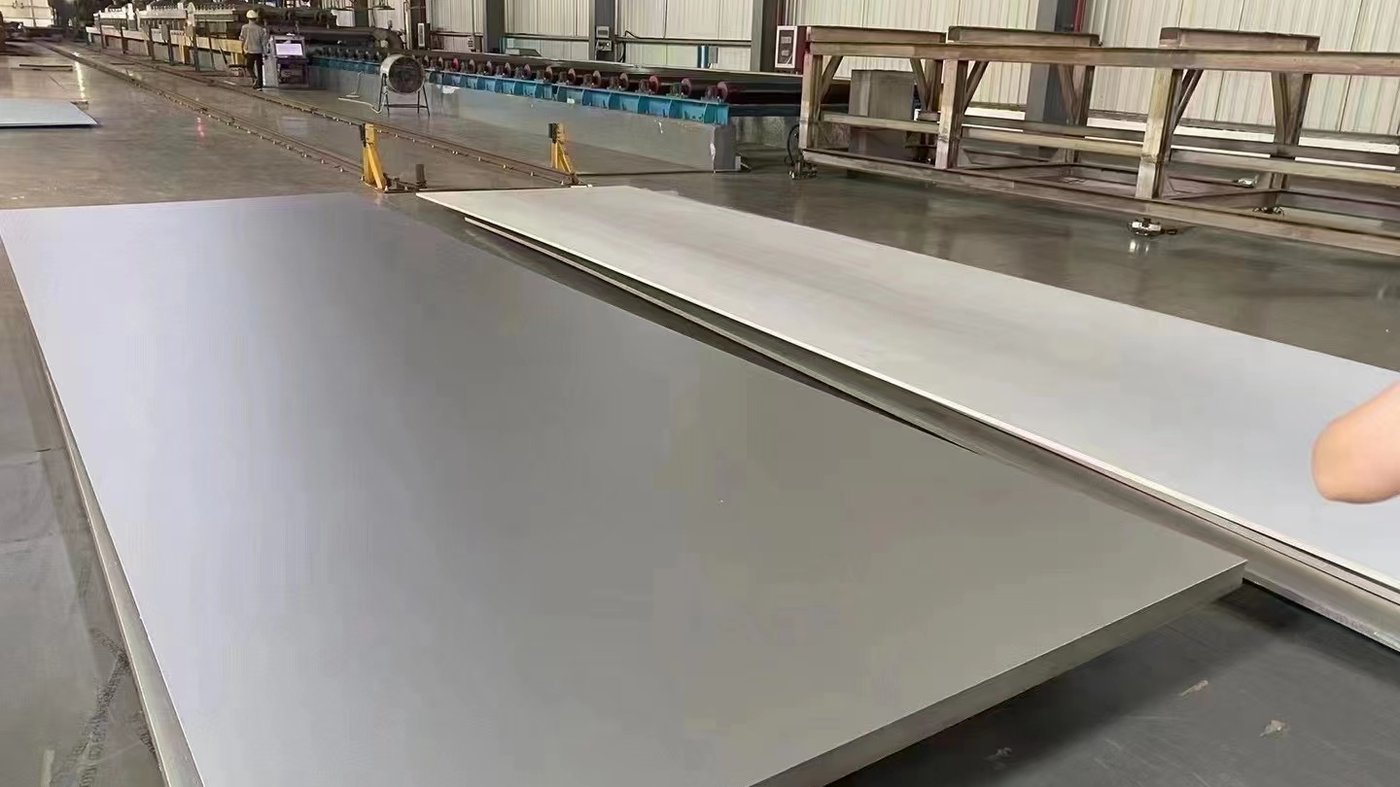
How Stainless Steel and Nickel Alloy Plates Are Made: From Slab to Finished Plate
Quick answer: Stainless steel and nickel alloy plates are made in six main steps: melting and casting the slab, hot rolling the slab on a plate mill at 1,100–1,250 °C, solution annealing to restore corrosion resistance, pickling to remove scale, straightening and cutting to size, then testing and certification. A "plate" is any flat-rolled product thicker than 4.76 mm (3/16 in); thinner material is sheet. The mill you choose matters less than the control points in this process — each one leaves a fingerprint on flatness, surface quality and mechanical properties that you inherit when you machine or weld the plate.
If you buy plate for pressure vessels, heat exchangers, or machined components, understanding how the plate is made explains most of the questions that come up later: why two "identical" 316L plates behave differently in welding, why thick plate needs different yield values than thin sheet, and why edge condition and flatness depend on how the mill finished the job.
Step 1: Melting and Casting the Slab
Every plate starts as a slab, and every slab starts at the melt shop.
- AOD (Argon Oxygen Decarburization) is the standard route for stainless grades. Molten metal is refined in an AOD converter where carbon is removed by oxygen while argon stirring protects chromium from oxidation. AOD gives tight control of carbon, sulfur and nitrogen — which is why 304L, 316L and duplex grades are routinely produced to low-carbon limits.
- EF + ESR (Electroslag Remelting) is the route for demanding nickel alloys such as Inconel 718, Inconel 625 and Hastelloy C-276 in plate form. ESR remelts a consumable electrode under a molten slag layer, producing a dense, segregation-free ingot. For plate used in aerospace and energy applications, ESR or VAR (vacuum arc remelting) material is usually mandatory because it delivers the cleanliness and homogeneity that ultrasonic inspection standards require.
- Continuous casting produces slabs for commodity stainless grades (300 and 400 series). Slab thickness is typically 150–250 mm. Nickel alloys and some specialty grades are still ingot-cast and forged/rolled to slab because continuous casting their chemistry is difficult.
The slab's chemistry is the plate's destiny. Elements that will matter later — nitrogen in duplex plate, niobium in 347, molybdenum in 316L and 625 — are all locked in here, and a good mill test certificate will trace every value back to this heat.
Step 2: Hot Rolling the Plate
The slab is reheated to 1,100–1,250 °C (depending on grade — duplex grades are reheated hotter, around 1,180–1,240 °C, nickel alloys cooler to control grain growth) and rolled on a plate mill or hot strip mill.
- Plate mills use reversible four-high stands: the slab passes back and forth, and each pass reduces thickness by controlled amounts until the target gauge is reached. Plate can be produced up to ~300 mm thick by cross-rolling techniques, though most commercial plate is 3–100 mm.
- Hot strip mills run the rolled material through to coil; plate from strip mill routes is later cut from coil or sold as "strip mill plate," typically limited to lighter gauges and widths.
Two things happen during hot rolling that buyers should understand. First, the rolling direction creates grain flow anisotropy — mechanical properties along the rolling direction differ from those across it, which matters for designs loaded in specific directions. Second, the final rolling temperature determines microstructure: finish rolling too cold on a duplex plate leaves harmful intermetallic phases; finish rolling 321 at the wrong temperature affects Ti(C,N) precipitation.
For wide plate, some mills cross-roll — rotate the piece 90° between passes so elongation happens in both directions, equalizing properties and reducing anisotropy. Aerospace and pressure-vessel specs sometimes require this.

Step 3: Solution Annealing
Hot-rolled stainless plate comes out of the mill with a sensitized microstructure: chromium carbides have precipitated at grain boundaries during cooling, which destroys corrosion resistance. Solution annealing fixes this.
- Austenitic grades (304L, 316L, 321, 310S): annealed at 1,040–1,150 °C and rapidly water quenched. The quench must pass through 850–450 °C fast enough to prevent carbides re-precipitating. This is why thick 316L plate can be harder to anneal properly than thin sheet — the core of thick sections cools slower.
- Duplex grades (2205, 2507): annealed at 1,020–1,120 °C, water quenched. Time-temperature control is critical; too cold or too slow promotes sigma phase, which devastates toughness and corrosion resistance.
- Nickel alloys (625, C-276, 400): each has its own window — Inconel 625 is typically annealed at 950–1,080 °C depending on whether the goal is stress relief or full recrystallization; Hastelloy C-276 at 1,120–1,170 °C followed by rapid quench.
Annealing also recrystallizes the deformed grain structure from hot rolling, which is why annealed plate has more uniform, predictable mechanical properties than as-rolled material.
Step 4: Pickling and Surface Finishing
The annealed plate is covered in oxide scale. Pickling removes it in a mixed nitric-hydrofluoric acid bath, revealing the mill finish.
- No. 1 finish is the standard hot-rolled plate finish: annealed and pickled, dull gray-white, with visible rolling texture. It is the default for industrial plate.
- 2D / 2B finishes apply to cold-rolled material, not plate — if a supplier offers "2B plate," they mean cold-rolled sheet.
- For decorative or sanitary work, plate can be ground (No. 4) or polished, adding cost per square meter.
The pickling step also removes the chromium-depleted layer beneath the scale, restoring full corrosion resistance. Poorly pickled plate has a phenomenon called "heat tint shadow" — subsurface chromium depletion that survives pickling and initiates rust in service even though the base alloy is sound. Good mills pickle, rinse, then verify.
Step 5: Straightening, Cutting and Edge Preparation
Plate leaves the mill flat within tolerance, but handling, quenching and cutting can distort it. Mills use roller levelers and press straighteners to bring flatness within spec — typically 5 mm/m or better for standard plate, tighter for machined applications.
Cutting options, in increasing order of quality:
| Method | Thickness range | Edge quality | Heat-affected zone |
|---|---|---|---|
| Shearing | ≤ 12 mm typical | Good, work-hardened edge | None |
| Plasma cutting | 3–100 mm | Fair, dross on bottom | Moderate, needs grinding |
| Laser cutting | 3–25 mm | Excellent | Narrow |
| Waterjet | 3–150 mm | Excellent, no heat | None |
| Abrasive saw | ≤ 150 mm | Very good | Minimal |
For nickel alloys, waterjet and laser are preferred — plasma cutting leaves a heat-affected zone with oxide inclusions that must be ground out before welding, or weld defects follow. If your supplier cuts plate to size, ask which method they used and whether HAZ removal is included.
Step 6: Testing, Certification and Marking
Before shipment, plate is tested against its specification:
- Tensile test per ASTM E8 — yield, tensile, elongation. Note that thick plate often shows lower yield in the core; specs like ASME II allow grade-dependent adjustments.
- Impact test (Charpy V-notch) for pressure-retaining applications, especially duplex and low-temperature service grades.
- Ultrasonic inspection per ASTM A578 for plate destined for pressure equipment — detects internal laminations from the casting/rolling process.
- Intergranular corrosion test (ASTM A262 Practice E for 316L) proving the anneal was done right.
- Hardness, flattening, dimensional checks against the relevant ASTM/EN product standard (A480 in the US system governs general plate requirements).
Every plate then gets stamped or ink-marked with heat number, grade, size and standard — and an EN 10204 3.1 mill test certificate links each mark to the heat's chemistry and test results. If you are new to reading MTCs, our guide on how to read a mill test certificate for nickel alloys walks through the fields line by line.
Common Grades Supplied in Plate Form
| Grade | UNS | Standard | Key strength | Typical use |
|---|---|---|---|---|
| 304/L | S30403 | ASTM A240 | General corrosion | Food, chemical, architectural |
| 316/L | S31603 | ASTM A240 | +2.5–3% Mo, chloride resistance | Marine, pharma, chemical |
| 321 | S32100 | ASTM A240 | Ti-stabilized | Heat exchangers, 500–800 °C |
| 310S | S31008 | ASTM A240 | 25Cr-20Ni | Furnace parts, 1,000 °C |
| 2205 | S32205 | ASTM A240 | Duplex, high strength | Oil & gas, desalination |
| 904L | N08904 | ASTM B625 | High Ni-Mo-Cu | Sulfuric acid, seawater |
| Inconel 625 | N06625 | ASTM B443 | Creep and pitting resistance | Aerospace, offshore, chemical |
| Inconel 718 | N07718 | ASTM B670 | Aged to 1,300+ MPa | Turbines, rocket engines |
| Monel 400 | N04400 | ASTM B127 | HF and hydrofluoric service | Chemical, marine |
| Hastelloy C-276 | N10276 | ASTM B575 | Ultimate wet-chloride resistance | FGD, pollution control |
For weight estimation before you order, use our plate, bar and pipe weight calculator guide — plate weight is simply length × width × thickness × density, but the guide covers the density values per grade so your RFQs arrive with realistic tonnage.
What Changes Between Thin and Thick Plate
Thickness is not just a scaling factor — the metallurgy changes:
- Quench severity. A 5 mm plate water-quenches uniformly; a 80 mm plate's core cools slowly enough to allow carbide or sigma precipitation in borderline grades. Specifiers of thick 316L or 2205 plate should ask about the mill's quench facilities.
- Mechanical property gradients. Standards reduce required yield for thicker sections (e.g., ASTM A240 316L requires 170 MPa yield up to 25 mm, less above), acknowledging the gradient.
- Ultrasonic quality. Thick plate from ingot-cast material has more chance of internal indications; A578 Level B/C inspection is standard practice for pressure vessel plate over 25 mm.
- Welding preheat and interpass control. Thick duplex plate welds need interpass temperature limits to avoid sigma phase in HAZs; thick 718 plate weldments need post-weld solution treatment per AMS 5662 practices — see our Inconel 718 heat treatment guide.
FAQ
Q: What is the difference between plate and sheet? A: In the ASTM system, plate is flat-rolled product ≥ 4.76 mm (3/16 in) thick and ≥ 250 mm wide; thinner is sheet. In EN standards the boundary is 3 mm. The distinction matters because product standards, tolerances and testing differ.
Q: Can I get 316L plate cut to size with polished edges? A: Yes. Most service centers offer waterjet or laser cutting to your drawings. Specify edge condition (deburred, squareness tolerance) and whether HAZ removal is required — for welded applications, always request HAZ removal.
Q: Why does my plate have wavy edges or a slight bow? A: Roller leveling cannot remove all distortion from heavy plate, especially after flame cutting. ASTM A480 flatness tolerances allow bow of up to 5 mm/m for plate under 50 mm. If you need tighter flatness for machining, specify it at order and expect stress-relief annealing to be quoted.
Q: Is hot-rolled plate weaker than cold-rolled sheet? A: In yield strength, generally yes for austenitic grades — cold work strengthens sheet substantially. Hot-rolled annealed 304L plate typically shows 210–260 MPa yield; full-hard 304 sheet can exceed 700 MPa. Corrosion resistance is identical after proper annealing.
Q: How is nickel alloy plate different from stainless plate? A: The process chain is the same, but melt practice (ESR/VAR), annealing windows and testing are stricter. Nickel alloys like 625 and C-276 are also far more sensitive to contamination during cutting and welding — dedicated grinding wheels and clean shop practices are required.
Q: What certificate comes with plate? A: EN 10204 3.1 MTC as standard, showing heat chemistry, tensile results, and the tests your PO specified (impact, IGC, UT). 3.2 (third-party witnessed) is available for pressure equipment and offshore projects.
Shanghai Hangbo Alloy Group
🌐 Website: www.hangbo-metal.com
📧 Email: Craliey1382@gmail.com
💬 WhatsApp: +86 19169850074
📞 Tel: +86 19169850074
📍 Address: No. 388 Songhuang Rd, Qingpu District, Shanghai, China
👤 Contact Person: Tiffany Luo