 Hangbo Alloy Group
Forged Round Billets & Discs: How to Read Size Marks and Specify Grade
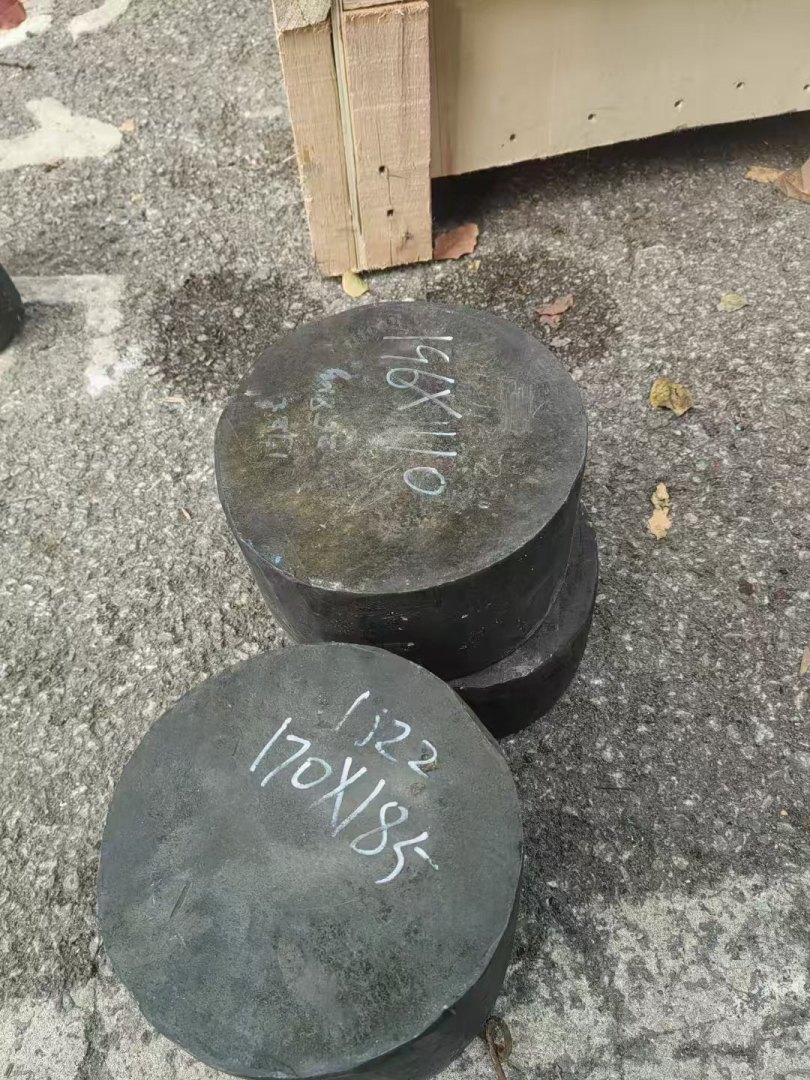
Quick answer: A forged round billet or disc is the starting stock for forging and heavy machining — a short, fat cylinder (diameter × height) cut or upset-forged from an ingot, supplied as-forged or rough-turned. The chalk marks on our yard stock read "160×110" and "170×185", meaning 160 mm diameter × 110 mm tall and 170 mm diameter × 185 mm tall. Specify the diameter × height (or OD for a disc), the grade, the condition (as-forged / rough-turned / proof-machined) and any ultrasonic or macro-etch check — a billet is a blank, not a finished part, and the forge or machine shop turns it into a flange, ring, gear blank or shaft.
What a forged round billet actually is
It is forged stock: a cylindrical piece produced by forging (open-die or upsetting) or by cropping a forged bar, then often rough-turned to remove scale and surface defects. The geometry is the giveaway — a billet is long relative to its diameter, a disc (or block) is short and wide. Either way it is the raw material a forge or machine shop starts from, never the delivered component.
The marks painted on the top face are the size call-out:
- "160×110" → 160 mm outside diameter, 110 mm height.
- "170×185" → 170 mm outside diameter, 185 mm height.
- A standalone number like "1122" is usually a heat / cast or works order number, not a dimension.
Why buyers specify billets instead of rolled bar
Rolled round bar tops out at a certain diameter and is limited by mill capacity. Forged billets fill the gap:
- Large cross-sections — diameters from ~100 mm up to 1000 mm+ that rolled bar cannot economically supply.
- Soundness — forged stock has better internal integrity than cast, because the ingot has been worked (see our cast vs forged flanges guide).
- Grain flow follows the shape — forging aligns the grain to the part, which matters for fatigue and impact.
- Forge-ready — a forge buys billets to upset, ring-roll or block-forge into finished shapes such as our Inconel 625 forged rings or machined disc blanks.
Typical sizes and how the marks read
| Dimension | Common range | Marked as | Notes |
|---|---|---|---|
| Diameter (OD) | 100–1000 mm | First number | Largest forged round we regularly supply |
| Height / length | 80–600 mm (disc) up to several m (billet) | Second number | "160×110" = Ø160 × H110 |
| Weight per piece | 10–2000+ kg | Calculated | Use the weight calculator |
| Out-of-round / taper | ≤ 1–2% of dia | Not usually marked | Agreed in the condition spec |
A disc with 170 mm diameter and 185 mm height weighs roughly 30–35 kg in steel (density ~7.85 g/cm³); the same in a nickel alloy such as Inconel 625 is ~36–42 kg because of the higher density (~8.4 g/cm³).
Materials and grades we supply as billets / discs
| Family | Example grades | Typical use of the forged blank |
|---|---|---|
| Carbon & low-alloy steel | A105, A350 LF2, 4140, 4340 | Flanges, blocks, shafts |
| Stainless | 304/304L, 316/316L, F6NM, 17-4PH | Corrosion parts, valve bodies |
| Duplex & super duplex | 2205, F51, F53, F55 | Offshore, seawater service |
| Nickel alloys | Inconel 600/601/625, Incoloy 800/825, Hastelloy C-276, Monel 400 | Heat, corrosion and high-strength parts |
| Titanium | Gr2, Gr5 (Ti-6Al-4V) | Aerospace, marine |
As-forged vs rough-turned vs proof-machined
| Condition | Surface | Dimensional freedom | When to choose |
|---|---|---|---|
| As-forged | Scaled, rough, +/- several mm | Least | You will machine everything away |
| Rough-turned (peeled) | Scale removed, +/- 2–3 mm | Better | Removes surface defects; common for billets |
| Proof-machined | Machined faces, +/- 1 mm | Best | When you need a known sound surface for UT |
Most buyers take rough-turned — it strips the decarburized and defect-prone surface layer so ultrasonic testing actually finds internal flaws instead of surface noise.
What quality checks belong on a billet RFQ
- Ultrasonic testing (UT) to a referenced standard (e.g. ASTM A388 / EN 10228-3) for critical forgings.
- Macro-etch ( sulphur print / step-down) to reveal pipe, segregation and grain.
- Chemical analysis against the grade, with an MTC per how to read a mill test certificate.
- Traceability — heat number painted or stamped, matching the MTC.
Forged-round-billet RFQ checklist
- Diameter × height (or length) in mm.
- Grade / specification (e.g. ASTM A182 F316, Inconel 625).
- Condition: as-forged, rough-turned, or proof-machined.
- Quantity and whether cut from a longer forged bar or made as a single upset forging.
- Any UT, macro-etch, or hardness requirement.
- Delivery state: raw to your forge, or finished-machined by us.
FAQ
Q: Is a "billet" the same as a "disc"? A: No. A billet is long relative to its diameter (bar-like forging stock); a disc or block is short and wide. Both are cylindrical forging blanks — the photo shows discs (height close to or greater than a small fraction of diameter).
Q: What do the painted numbers mean — size or heat number? A: Pairs like "160×110" are diameter × height in mm. A single long number such as "1122" is normally a heat / works order number for traceability, not a dimension.
Q: Should I buy as-forged or rough-turned? A: Choose rough-turned unless you will machine the entire surface away — turning removes the defective skin so UT and visual inspection are meaningful.
Q: Can I get nickel-alloy billets in these sizes? A: Yes. Inconel, Incoloy, Hastelloy and Monel are routinely supplied as forged rounds and discs in the 100–600 mm diameter band; larger sizes are upset-forged to order.
Q: Why not just buy a finished flange instead of a billet? A: If you are a forge or machine shop you want the blank and your own machining; if you need the finished part, a machined disc or flange blank or a rolled forged ring is the shorter route.
Shanghai Hangbo Alloy Group
🌐 Website: www.hangbo-metal.com
📧 Email: Craliey1382@gmail.com
💬 WhatsApp: +86 19169850074
📞 Tel: +86 19169850074
📍 Address: No. 388 Songhuang Rd, Qingpu District, Shanghai, China
👤 Contact Person: Tiffany Luo