 Hangbo Alloy Group
Inconel 625 Forged Ring (UNS N06625): Rolled Ring Forging, Sizes and Uses
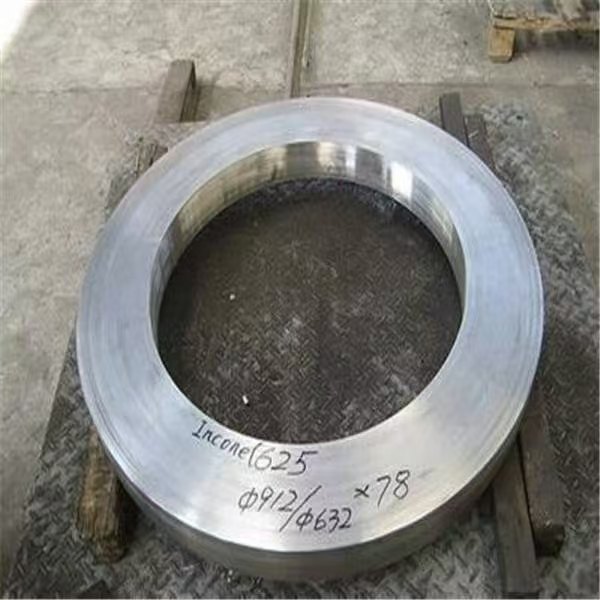
Quick answer: An Inconel 625 forged ring (UNS N06625) is a seamless annular forging made by ring-rolling a pierced blank — no weld seam, forged grain flow all the way round. The ring in our yard is marked "Ø912/Ø632 ×78", meaning 912 mm outside diameter, 632 mm inside diameter and 78 mm axial height (a 140 mm wall). It pairs 625's corrosion resistance — seawater, acids, sour gas, from cryogenic to ~650 °C — with the soundness of a wrought forging. Specify OD / ID / height, grade N06625, standard (ASTM B564 / ASME SB564), condition and any ultrasonic test.
What a forged ring actually is
A rolled ring forging starts as a pierced disc or upset billet, then is widened and thinned on a ring-rolling mill into a seamless annulus. Because there is no weld and the metal has been worked circumferentially, the grain flow follows the ring — exactly what you want for pressure, rotating and fatigue-loaded parts. For the forged-stock side of this, see our forged round billets guide.
Reading the mark "Ø912/Ø632 ×78"
| Mark | Meaning | Value |
|---|---|---|
| Ø912 | Outside diameter | 912 mm |
| Ø632 | Inside diameter (bore) | 632 mm |
| ×78 | Axial height / face width | 78 mm |
| Wall | (OD − ID) / 2 | 140 mm |
That notation is the standard way a forge calls out a ring: two diameters and a height, all in millimetres.
Why specify 625 for a ring
| Driver | Why 625 fits |
|---|---|
| Seawater / marine | High PREN, resists pitting and crevice corrosion where 316 fails |
| Sour gas (H₂S/CO₂) | NACE MR0175 compliant in the right condition |
| Strength + corrosion | ~827 MPa tensile, far above austenitic stainless |
| Temperature span | Usable from cryogenic to about 650 °C |
| No weld seam | Seamless ring avoids the weak line of a welded ring |
If your service is pure high heat rather than corrosion, a 601 ring or billet may be the better call; for load where strength is secondary, see cast vs forged.
Size envelope we roll
| Parameter | Typical range |
|---|---|
| Outside diameter (OD) | 200 mm – 3000+ mm |
| Inside diameter (ID) | 100 mm – 2800 mm |
| Height (axial) | 40 mm – 500 mm |
| Wall | 25 mm – 500 mm |
| Weight | up to several tonnes |
The 912 / 632 × 78 ring in the photo sits mid-range — a heavy-wall industrial ring, not a thin-section bearing race.
Standards and grades
- Inconel 625: ASTM B564 / ASME SB564, UNS N06625 (also supplied to NACE MR0175).
- Other ring grades we roll: Inconel 600/601/718, Incoloy 800/825, Hastelloy C-276, Monel 400, duplex and austenitic stainless (304/316/F6NM), and carbon/low-alloy steel.
- Heat-treat condition: annealed (solution-annealed) is standard for 625; age-hardened variants exist for higher strength.
Mechanical properties (625, annealed, ASTM B564)
| Property | Minimum |
|---|---|
| Tensile strength | ~827 MPa (120 ksi) |
| 0.2% yield strength | ~414 MPa (60 ksi) |
| Elongation | ≥30% |
| Hardness | ~≤250 HB typical |
These are the B564 minimums; typical mill values are at or above them. Confirm on the MTC per our mill-test-certificate guide.
Quality and inspection on a forged ring
- Ultrasonic testing to ASTM A388 / EN 10228-3 across the ring body and faces.
- Dimensional check of OD, ID, height, concentricity and flatness of the faces.
- Chemical analysis and grain-size / macro-etch as agreed.
- Traceability — heat number on the ring and on the cert.
Inconel 625 forged-ring RFQ checklist
- OD / ID / height (mm) — or give ID and wall if easier.
- Grade N06625 and standard (B564/SB564), NACE if required.
- Condition: annealed, or age-hardened for higher strength.
- Quantity and any machining (facing, drilling, contouring) — or leave as-rolled for your shop.
- UT and dimensional tolerance (e.g. face flatness, OD/ID bands).
- Delivery: raw forged ring, or finish-machined to a disc/flange blank.
FAQ
Q: Is a forged ring stronger than a welded ring? A: Yes for the same material — the seamless forged ring has continuous circumferential grain flow and no weld seam, so it resists pressure, fatigue and creep better than a rolled-and-welded ring.
Q: What does "Ø912/Ø632 ×78" mean exactly? A: Outside diameter 912 mm, inside diameter (bore) 632 mm, and 78 mm face height. The wall is (912−632)/2 = 140 mm.
Q: Can you supply 625 rings to NACE? A: Yes, Inconel 625 is qualified to NACE MR0175 in the appropriate condition; state the NACE requirement on the RFQ so the heat and hardness are controlled.
Q: Forged ring or machined disc for my flange? A: If the part is annular (a ring, collar or hollow cylinder), a rolled ring forging is the efficient route; if it is a solid faced disc or blind flange, a machined forged disc is usually shorter.
Q: How heavy is a 912/632×78 ring in 625? A: Roughly the volume of the annulus (π/4·(0.912²−0.632²)·0.078 m³ ≈ 0.026 m³) × density ~8.44 g/cm³ ≈ 220 kg before machining — use the weight calculator for exact planning.
Shanghai Hangbo Alloy Group
🌐 Website: www.hangbo-metal.com
📧 Email: Craliey1382@gmail.com
💬 WhatsApp: +86 19169850074
📞 Tel: +86 19169850074
📍 Address: No. 388 Songhuang Rd, Qingpu District, Shanghai, China
👤 Contact Person: Tiffany Luo