 Hangbo Alloy Group
Inconel 601 Round Bar (UNS N06601): Properties, Sizes and Where It's Used
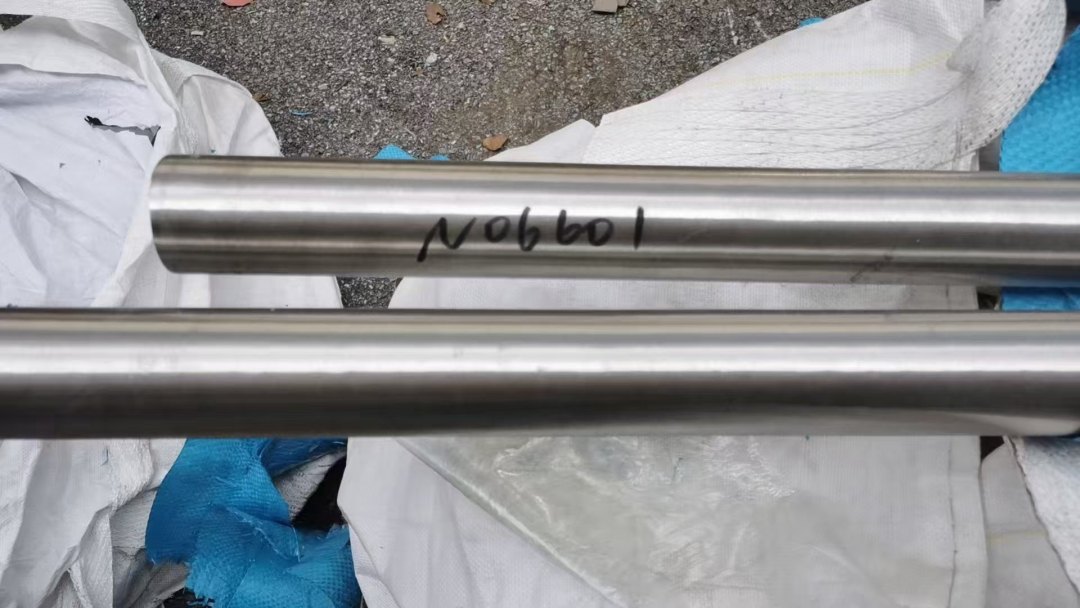
Quick answer: Inconel 601 (UNS N06601) is a nickel-chromium alloy with about 23% chromium plus aluminium, which gives it outstanding oxidation resistance up to roughly 1200 °C and useful strength to ~1000 °C. As a round bar it is normally supplied bright-peeled or centreless-ground in diameters from about 6 mm to 300 mm, and used for furnace parts, heat-treat fixtures, radiant tubes and aerospace / chemical components. When you order, specify UNS N06601, the diameter and tolerance, annealed (bright) condition, and the standard — usually ASTM B166 / ASME SB166. The black marker "N06601" on our stock is exactly that UNS grade call-out.
What Inconel 601 is (and why the "N06601" mark)
UNS N06601 is the unified numbering for Inconel 601. The "N" prefix means nickel alloy; the "06601" is the grade. It is a solid-solution strengthened alloy whose key addition is aluminium (1.0–1.7%), which forms a tight, self-healing Al₂O₃ scale that resists spalling in cyclic heat.
Nominal composition:
| Element | Ni | Cr | Al | Fe | Other |
|---|---|---|---|---|---|
| Typical wt% | ≥58 (bal) | 21–25 | 1.0–1.7 | 13–17 | Mn, Si, Cu, C |
Why 601 and not 600 or 625
| Alloy (UNS) | Cr | Headline strength | Best at | Choose 601 when… |
|---|---|---|---|---|
| 600 (N06600) | 14–17% | Good up to ~650 °C | General corrosion + moderate heat | You need corrosion more than extreme heat |
| 601 (N06601) | 21–25% | Excellent to ~1200 °C | Cyclic oxidation, furnace service | Heat and oxidation dominate the spec |
| 625 (N06625) | 20–23% | High strength + seawater | Marine, sour, high strength | You need strength/corrosion over pure heat |
For pure high-temperature oxidation resistance, 601 beats 600; for strength and seawater, 625 is the better call.
Inconel 601 round bar: sizes and condition
| Condition | Surface | Typical diameter | Use |
|---|---|---|---|
| Bright-peeled (peeled & drawn) | Smooth, bright | 6–120 mm | Most stock, machinable |
| Centreless-ground | Tight tolerance, bright | 6–80 mm | Closer size, less machining |
| Black hot-rolled | Scaled | 50–300 mm | Large sizes, heavy machining |
We stock bright bars in the common engineering diameters and supply larger peeled and ground sizes to order. The bar in the photo is bright-peeled stock marked "N06601" for grade identification.
Mechanical properties (annealed)
| Property | ASTM B166 minimum | Typical mill value |
|---|---|---|
| Tensile strength | ~655 MPa (95 ksi) | 760–830 MPa |
| 0.2% yield strength | ~310 MPa (45 ksi) | 310–400 MPa |
| Elongation | ≥30% | 30–45% |
| Hardness | — | ~170–220 HB |
601 is not age-hardenable like 718 or X-750 — its strength comes from solid-solution strengthening, so there is no precipitation-hardening heat treatment to specify. For the age-hardening family, see our Inconel 718 heat-treatment guide.
Temperature and oxidation behaviour
- Continuous service: up to ~1150–1200 °C in air, with an adherent scale.
- Cyclic heating/cooling: the aluminium oxide scale resists spalling far better than the chromium-only scale of 600.
- Carburization / nitriding: 601 resists high-temperature carburizing atmospheres better than most austenitics.
- Creep: usable for load-bearing furnace parts up to ~1000 °C; above that, design for low stress.
Typical applications
- Furnace muffles, radiant tubes, retorts and trays.
- Heat-treat baskets, fixtures and radiant-cup burners.
- Aerospace and gas-turbine exhaust components.
- Chemical and petrochemical high-heat hardware.
- Kiln and incinerator parts.
Machining and welding notes
- Machinable like other nickel alloys: rigid setup, low speed, positive rake, plentiful coolant; it work-hardens, so avoid dwell.
- Weldable with matching 601 filler (ERNiCrFe-11) or overalloyed 625 filler for some joints; keep clean and use low heat input.
- Bars are usually supplied annealed and ready to machine — no post-weld heat treatment is required for corrosion, though stress relief helps dimensional stability.
Inconel 601 bar RFQ checklist
- UNS N06601 (confirm not 600/625 by application).
- Diameter and tolerance (e.g. 50 mm h9, or centreless-ground).
- Condition: bright-peeled or ground.
- Length: random mill length or cut-to-length, quantity.
- Standard: ASTM B166 / ASME SB166, with MTC per mill-test-certificate reading.
- If forged sizes are needed rather than rolled bar, see our forged round billets.
FAQ
Q: Is "N06601" the same as Inconel 601? A: Yes. N06601 is the UNS (Unified Numbering System) grade code for Inconel 601; you will see both used on mill certs and on the bar itself.
Q: Can 601 be heat-treated to get harder? A: No — it is solid-solution strengthened, not age-hardenable. Strength comes from chemistry and cold work; there is no precipitation-hardening step like Inconel 718.
Q: 601 or 600 for a furnace fixture? A: For continuous or cyclic high heat (above ~900 °C), 601 is the safer choice because of its aluminium oxide scale. For lower-temperature corrosion service, 600 is often enough and cheaper.
Q: What diameter bar can I get? A: Standard bright bar runs from about 6 mm to 120 mm from stock, with larger peeled and ground diameters to ~300 mm on order; weight per metre follows the alloy weight formula.
Q: Does 601 need PWHT after welding? A: For corrosion and oxidation service, no post-weld heat treatment is required; a stress-relief anneal is optional for dimensional stability of machined parts.
Shanghai Hangbo Alloy Group
🌐 Website: www.hangbo-metal.com
📧 Email: Craliey1382@gmail.com
💬 WhatsApp: +86 19169850074
📞 Tel: +86 19169850074
📍 Address: No. 388 Songhuang Rd, Qingpu District, Shanghai, China
👤 Contact Person: Tiffany Luo