 Hangbo Alloy Group
Machined Forged Discs & Flange Blanks: Finish, Tolerances and RFQ Checklist
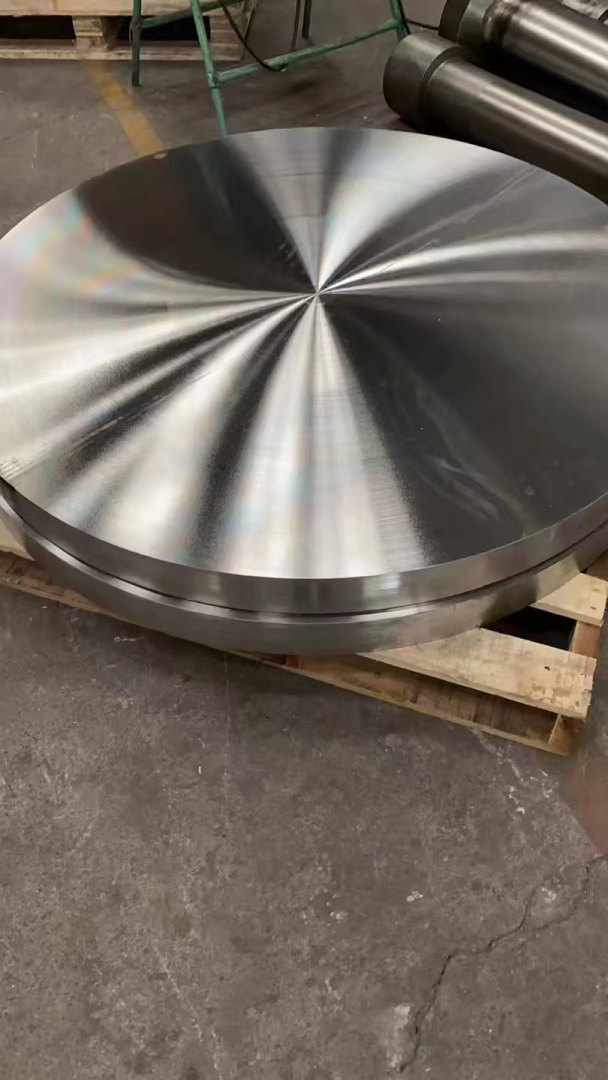
Quick answer: A machined forged disc — often called a flange blank or simply a machined disc — is a forged round whose faces have been turned and surface-ground to a bright, flat, finished condition. The radial "sunburst" pattern on the disc in our yard is the grinding mark left by a rotary surface grinder, and it is the visual signature of a flat, parallel, ready-to-finish blank. It is the starting point for blind flanges, weld-neck flange blanks, gear blanks and machined components. Specify diameter × thickness, grade, face flatness and surface finish (Ra, or "sunburst-ground"), and any drilling or boring you want completed.
What a machined forged disc is
Start with a forged round billet or disc, then machine both faces (and usually the OD) on a lathe and finish at least one face on a rotary surface grinder. The result is a disc with:
- Two flat, parallel faces.
- A known, defect-free surface (scale and the forged skin are gone).
- A bright, low-Ra finish suitable for sealing or further machining.
Why machine it instead of leaving it as-forged
| As-forged disc | Machined disc blank |
|---|---|
| Scaled, out-of-flat by mm | Flat to 0.1–0.5 mm or better |
| Unknown surface soundness | Skin removed, UT-able |
| Needs full machining by you | Faces ready; you only drill/bore |
| Cheaper raw | Shorter route to a finished flange |
For a flange or sealed component, the machined blank saves the buyer a rough-machining operation and removes the defective surface layer so inspection is meaningful.
The "sunburst" finish, explained
The concentric/radial pattern is produced by a rotary surface grinder (or a polishing head) spinning against the slowly rotating disc. It is:
- Mostly cosmetic on the visible face, but it also confirms the face was ground flat.
- Quantified by Ra (roughness average) — typical machined discs run Ra 0.8–3.2 µm; a finer "mirror" lap goes lower.
- Not a defect — the rainbow iridescence is thin-film interference on freshly ground metal, normal on bright stainless and nickel alloys.
If you need a specific Ra or a fully polished face, state it; "sunburst-ground" alone describes the look, not a number.
Typical sizes we supply
| Parameter | Common range |
|---|---|
| Diameter | 100 – 1500 mm |
| Thickness | 20 – 300 mm |
| Weight | up to ~1500 kg |
| Flatness (per face) | 0.1 – 0.5 mm typical |
The disc in the photo is a large, heavy blank — the kind used for a big blind or weld-neck flange.
Grades supplied as machined discs
| Family | Example grades | Common disc use |
|---|---|---|
| Stainless | 304/304L, 316/316L, F6NM, 17-4PH | Flanges, valve bodies, food/pharma |
| Duplex | 2205, F51, F53 | Offshore, seawater |
| Nickel alloys | Inconel 600/625, Hastelloy C-276, Monel 400 | Heat, corrosion, sour service |
| Carbon/low-alloy | A105, A350 LF2, 4140 | General-pressure flanges |
For an annular part rather than a solid disc, the route is a rolled forged ring instead.
Flatness, finish and tolerance to put on the RFQ
| Item | What to specify |
|---|---|
| Diameter & thickness | mm, with tolerance band (e.g. ±1 mm) |
| Face flatness | per face, or overall (e.g. 0.2 mm) |
| Parallelism of faces | if the disc stacks or seals |
| Surface finish | Ra value, or "sunburst-ground" / "mirror" |
| OD condition | as-turned, or ground to size |
| Holes/bore | drilled bolt circle, or centre bore, or none |
From blank to finished flange
A machined disc becomes a flange by:
- Drilling the bolt-hole circle (and any vent/tap holes).
- Boring a centre hole for a weld-neck or lap-joint flange.
- Welding a neck (weld-neck type) or leaving it blind.
- Inspecting to the flange standard (e.g. ASME B16.5 / EN 1092).
If you only need the blank, we stop at step 0; if you need the finished flange, we drill and bore it. See our cast vs forged comparison for why wrought blanks are preferred for pressure service.
Machined-disc RFQ checklist
- Diameter × thickness (mm).
- Grade / standard (e.g. ASTM A182 F316, A105).
- Face finish: sunburst-ground, specific Ra, or mirror.
- Flatness and parallelism requirements.
- Machining: plain blank, drilled bolt circle, or bored centre.
- MTC and any UT per mill-test reading; weight planning via the weight calculator.
FAQ
Q: Is the sunburst pattern a defect? A: No. It is the normal mark of a rotary surface grind and actually shows the face was ground flat. The iridescent sheen is thin-film interference on bright metal.
Q: Disc blank or forged ring — which do I need? A: Solid faced part (blind flange, gear blank, valve body) → machined disc. Hollow annular part (ring, collar, hollow cylinder) → rolled forged ring.
Q: Can you drill the bolt holes for me? A: Yes — supply the flange standard and size (or a bolt-circle drawing) and we deliver drilled and bored, not just the blank.
Q: What Ra can I get? A: Standard machined discs are around Ra 0.8–3.2 µm; specify a lower Ra or a mirror lap if the sealing face demands it.
Q: Does machining remove the forged benefits? A: No. Machining only skins the surface; the forged grain flow and internal soundness remain. It is the same wrought blank, just brought to a finished, inspectable condition.
Shanghai Hangbo Alloy Group
🌐 Website: www.hangbo-metal.com
📧 Email: Craliey1382@gmail.com
💬 WhatsApp: +86 19169850074
📞 Tel: +86 19169850074
📍 Address: No. 388 Songhuang Rd, Qingpu District, Shanghai, China
👤 Contact Person: Tiffany Luo