 Hangbo Alloy Group
Forged vs Rolled Large-Diameter Bar: Grain Flow, UT Soundness and When Forging Is Mandatory
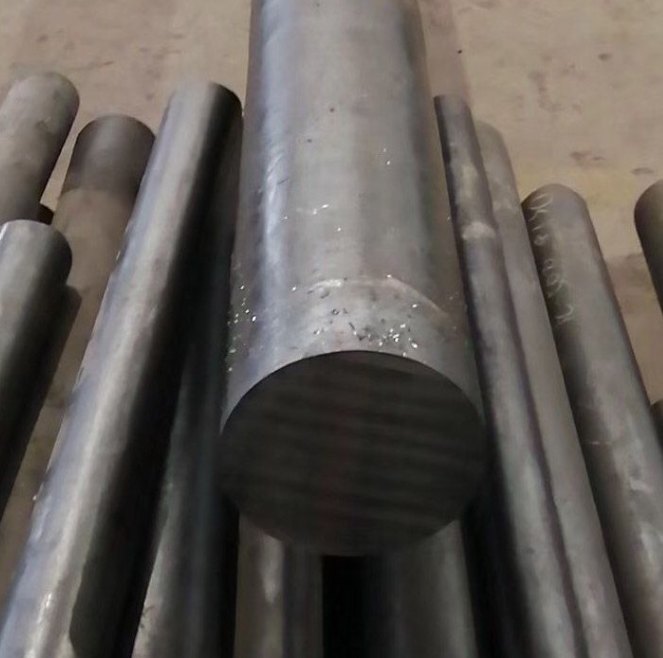
Quick answer: For large-diameter bar (roughly above 150–200 mm), the choice is hot-rolled or forged — and forged wins when the part is fatigue-loaded, pressure-boundary, or needs verified internal soundness: forging breaks up the as-cast core, produces radial grain flow, and responds far better to ultrasonic testing. If your spec cites UT per ASTM A388 with tight acceptance classes, plan on forged.
What's Actually Different About a Forged Bar?
Hot-rolled bar comes from an ingot or continuous-cast bloom squeezed through rolls. Forging takes a cast or rolled billet and plastically works it with presses or hammers, usually with multiple reductions and rotations. The consequences:
| Property | Hot-rolled bar | Forged bar |
|---|---|---|
| Center soundness | Porosity/segregation possible in large sections | Collapsed and welded by heavy reduction |
| Grain flow | Longitudinal | Controlled — radial, longitudinal or per drawing |
| UT inspectability | Coarse as-cast core scatters sound in big sizes | Fine wrought structure, clean UT to class 1–3 |
| Size range | Economical to ~130–200 mm | Practical 150–500 mm+, blocks and discs beyond |
| Relative cost | 1.0 | 1.3–2.0 |
When Is Forged Bar Effectively Mandatory?
- Spec says so: many oil & gas, nuclear and aerospace specs (e.g. pressure classes above ASME limits, Norsok-type requirements) require forged or forged-and-machined stock with UT acceptance
- Fatigue service: rotating shafts, crank pins, tooling under cyclic load — forged grain flow resists crack initiation
- Large sections needing full UT: above ~200 mm, the as-cast core of rolled bar is hard to inspect reliably
- Non-standard shapes near-net: stepped shafts, blocks, discs — forging to shape saves machining, see forged discs and blocks and hollow forged cylinders
Stay with hot-rolled or peeled bar when sections are small, loads are static, and standard sizes fit — the premium buys nothing there. For everyday tolerances and surfaces, the peeled vs ground vs hot-rolled guide covers the selection.
What Tests Should a Forged Bar RFQ Include?
- UT: 100 % per ASTM A388 (or EN 10228-3), with acceptance class stated — "UT tested" without a class is unenforceable
- Tensile + impact per applicable spec, test location (surface vs mid-radius vs core)
- Grain flow / macroetch if grain-flow direction matters to the design
- Heat treatment condition and, for nickel grades, the exact AMS/ASTM callout — see how to read an MTR
- Prolongation pieces: keep test coupons traceable to the forging operation, not just the melt
FAQ
Q: Is a forged bar stronger than a rolled bar of the same grade? A: Tensile strength is similar — the grade's chemistry and heat treatment set it. What forging buys is toughness and consistency through the section, plus inspectability. Strength differences show up in design allowables only for very heavy sections.
Q: My drawing says Ø250 mm 316L bar. Is rolled OK? A: Rolled bar exists up to ~300 mm but the center quality thins out; for anything structural or welded afterward, most buyers go forged-and-turned at that size. Get both prices — sometimes rolled with full UT acceptance passes the spec cheaper.
Q: Does forging change corrosion resistance? A: No — same grade, same corrosion behavior after proper annealing. Heavy cold deformation can affect sensitization behavior in standard-carbon grades, which is why forged pressure parts are supplied solution annealed.
Shanghai Hangbo Alloy Group
🌐 Website: www.hangbo-metal.com
📧 Email: Craliey1382@gmail.com
💬 WhatsApp: +86 19169850074
📞 Tel: +86 19169850074
📍 Address: No. 388 Songhuang Rd, Qingpu District, Shanghai, China
👤 Contact Person: Tiffany Luo