 Hangbo Alloy Group
Stainless Steel Strip Slitting: Width Tolerance, Camber and Edge Quality Explained
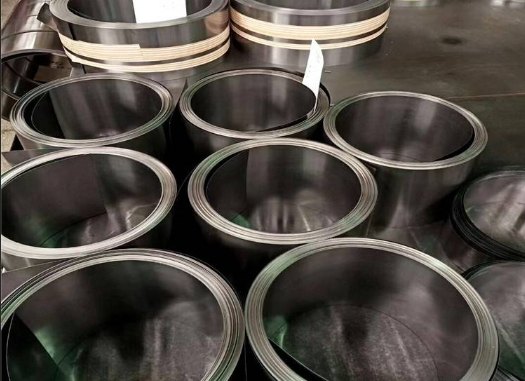
Quick answer: Slitting is how a wide stainless coil becomes narrow strip to your width — and the three quality words that decide whether the strip runs in your press are width tolerance (typically ±0.05–0.25 mm depending on class), camber (edge straightness, often ≤ 1 mm per 2 m for precision work), and edge condition ( slit, deburred, or dressed). Specify all three in the RFQ, or you'll get whatever the service center's standard running is.
What Width Tolerance Can Slitting Hold?
| Class | Typical width tolerance | Typical use |
|---|---|---|
| Commercial | ±0.15–0.25 mm | General fabrications, non-critical stampings |
| Precision | ±0.10 mm | Progressive dies, consistent feeding |
| Tight/precision-plus | ±0.05 mm or better | Stamping with pilot registration, tubing re-rolling |
The tolerance depends on strip thickness, yield strength and slit width — thinner, harder and narrower strip is harder to hold. Half-hard 301 holds a tighter window more easily than soft annealed 304 of the same gauge, because soft strip bows and wobbles more through the knives — one of the points covered in our coil & strip guide.
What Is Camber and Why Does It Jam My Feeder?
Camber is the strip curving sideways instead of running straight — the arc a free length of strip forms on a flat table. In a progressive die or tube mill, camber walks the strip off-center: pilots pick up off-position, tube mill rolls mis-form, scrap accumulates. Typical procurement language:
- General work: camber ≤ 2 mm per 2,000 mm
- Precision stamping/tube re-roll: ≤ 1 mm per 2,000 mm
Camber traces back to slitting set-up (knife side pressure, uneven blade clearance across width) and to as-rolled crown in the parent coil. Good slitters measure and certify it; average ones don't — so state the limit and ask for the measurement.
Which Edge Condition Should I Order?
- Standard slit edge: as-cut, slight burr — fine for most bending and forming
- Deburred / broken edge: burr minimized for handler safety and coating work
- Dressed or rolled edge: burr removed and edge worked smooth — required for some drawn parts and for re-rolling into tube where a burr initiates weld defects
If the strip re-rolls into tube, say so in the RFQ — the tube maker's weld quality starts at your slit edge, and A269/A213 tubing specs punish bad edges.
What Belongs in a Strip RFQ?
- Grade + condition (e.g. 301 1/2-hard, 304 annealed) with standard (ASTM A666, EN 10151)
- Thickness with tolerance class, width with tolerance class, camber limit
- Edge condition, coil weight and ID (core size — 300/400/508 mm matters for your uncoiler)
- Surface finish (2B, BA, 2R) and protective film if forming stays cosmetic
- Testing: mechanical properties per coil or per lot, flatness if post-slitting leveling is needed
FAQ
Q: Why can't I get ±0.02 mm width on soft 304 strip? A: Soft austenitic strip moves between knives and after tension release; the practical floor for stable width on soft material is around ±0.05 mm with precision tooling. If you need tighter, consider harder temper or edge dressing after slit.
Q: Does slitting affect the strip's mechanical properties? A: The slit edges are cold-worked locally, but the strip body is unchanged. What matters for forming is the parent coil's temper — see coil vs strip basics for definitions.
Q: How is strip packed for export? A: Eye-to-sky or eye-to-wall, paper/VCI interleaved, edge-protected and banded without carbon-steel contact — same contamination rules as bar and pipe in our export packing guide.
Shanghai Hangbo Alloy Group
🌐 Website: www.hangbo-metal.com
📧 Email: Craliey1382@gmail.com
💬 WhatsApp: +86 19169850074
📞 Tel: +86 19169850074
📍 Address: No. 388 Songhuang Rd, Qingpu District, Shanghai, China
👤 Contact Person: Tiffany Luo