 Hangbo Alloy Group
Stainless Steel Plate Price: What Drives It and How to Compare Quotes Fairly
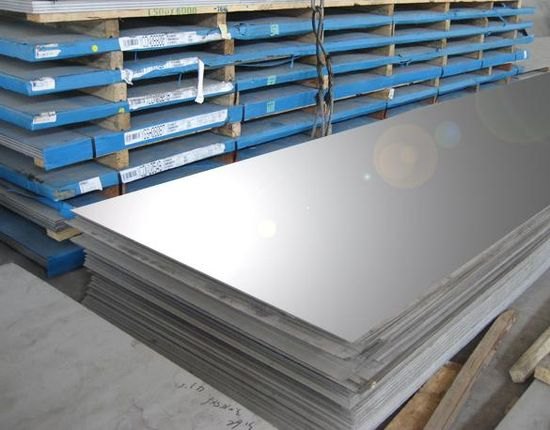
Quick answer: Stainless plate price is driven by four things: the alloy surcharge (nickel and molybdenum LME prices), plate size versus mill sizes, quantity, and processing (cutting, heat treatment, testing). Comparing quotes without normalizing these four is comparing apples to bolts — a "cheap" per-ton quote on small cut pieces can be 30 % more expensive per finished part.
What Actually Moves Stainless Plate Price?
| Cost driver | Impact | What you can control |
|---|---|---|
| Alloy surcharge (Ni, Mo) | 40–70 % of base price for 300-series | Timing, grade choice (e.g. 304 vs 316L) |
| Size vs mill dimensions | Buying 1,500 × 6,000 for a 300 × 300 part = buying scrap | Nesting, stock sizes, cut-to-size supply |
| Quantity | One-off pieces carry make-ready cost | Consolidate RFQs, accept mill multiples |
| Processing | Cutting, beveling, HT, UT each add cost | Only pay for what the drawing needs |
Nickel is the big lever: for 304/304L, roughly every $1,000/t LME move shifts plate price noticeably; 316L adds molybdenum on top — see 304L vs 316L for vessels for whether you actually need the Mo.
Why Do Two Quotes for the "Same" Plate Differ by 20 %?
Almost always one of these:
- Origin and mill tier — European/Japanese mills vs Chinese mills price differently, and so do their stockists. Certificates and UT traceability differ too.
- Tolerance basis — nominal thickness with standard ASTM A480 tolerance bills scale weight (often 2–5 % heavier); minimum-wall bills theoretical. Compare price per finished part, not per ton.
- Incoterms — FCA vs CIF vs DDP differs by freight, duty and insurance; add these back before comparing.
- Test scope — 3.1 MTR standard; PMI, UT, Charpy and third-party witness cost extra at the mill.
How Should I Compare Quotes Fairly?
Build one line per quote with: delivered price per piece (not per ton), grade and UNS, standard (A240/SA240), thickness basis, origin mill, test scope, lead time and payment terms. Two quotes become comparable the moment "per piece delivered" replaces "per ton FCA". For large programs, add scrap/yield: a supplier who cuts parts from their own stock sizes can beat a lower per-ton quote by 10–15 % in yield alone — see plate cutting methods.
Does Buying Stock Sizes Always Win?
For standard 2B/No.1 plate in common thicknesses, stock plate from a service center is cheapest and fastest. Mill-direct wins when you need: special widths/lengths (less trim loss), guaranteed single heat for the whole order, high-volume repeats, or special testing witnessed at the mill. One-off specialty sizes from the mill carry long lead times — a service center's remnant yard often has your size today.
FAQ
Q: Why is 316L so much more expensive than 304L right now? A: Molybdenum plus higher nickel content. The premium is typically 20–40 %, and it widens when Mo prices spike. Buy 316L only where chlorides or acids demand it.
Q: Is price locked when I place the PO? A: Only if the quote says so. Alloy surcharge contracts often float with LME monthly averages — for large orders, ask for a fixed-price validity window or a surcharge cap in writing.
Q: How do I estimate plate weight for a quick budget? A: Use 7.93 kg/m² per mm thickness for austenitic grades — a 6 mm × 2 × 6 m plate ≈ 570 kg. The full formulas for plate, bar and pipe are in our weight calculation guide.
Shanghai Hangbo Alloy Group
🌐 Website: www.hangbo-metal.com
📧 Email: Craliey1382@gmail.com
💬 WhatsApp: +86 19169850074
📞 Tel: +86 19169850074
📍 Address: No. 388 Songhuang Rd, Qingpu District, Shanghai, China
👤 Contact Person: Tiffany Luo