 Hangbo Alloy Group
Large-Diameter Stainless Pipe: A358 EFW vs Seamless — Classes, Sizes, Cost
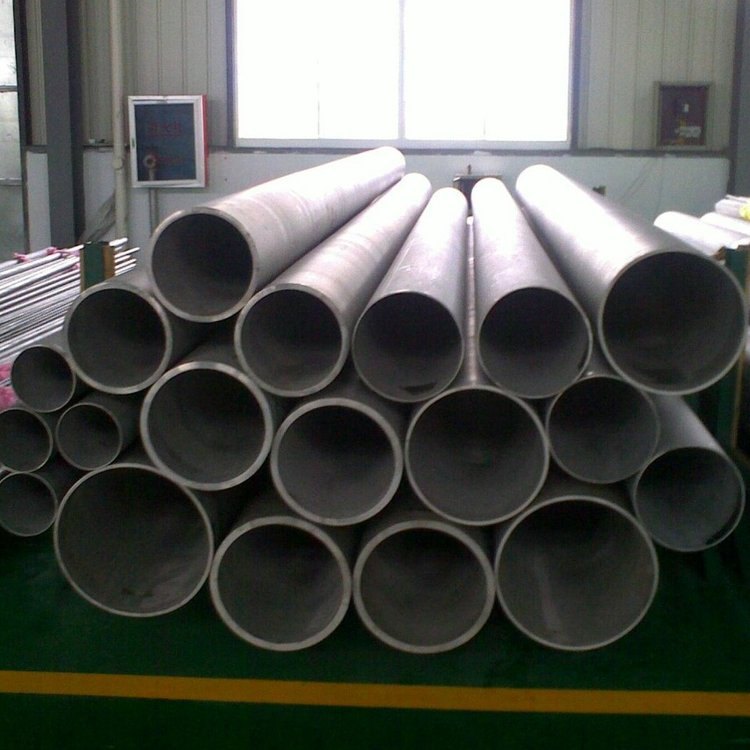
Quick answer: For large-diameter stainless pipe (roughly above NPS 24 / DN600), the practical choice is EFW (electric-fusion-welded) pipe per ASTM A358 or A778, not seamless — seamless mills stop offering big sizes economically, and properly welded and tested EFW meets pressure codes at a fraction of the price. Spec the weld seam with 100 % RT or UT and the argument disappears.
What Are the Route Options for Big Stainless Pipe?
| Route | Size window | Standard | Relative cost | Notes |
|---|---|---|---|---|
| Seamless (A312) | Practical to ~NPS 24–30 | A312 | High and climbing | Mill availability thins fast above 600 mm |
| EFW, rolled plate, longitudinal weld | NPS 6 up to 100"+ | A358 (or A778 unannealed classes) | 0.5–0.8 | Plate rolled, welded, expanded; full-body testing |
| Welded from coil, spiral | Large OD, low-pressure | A778 / API-type practice | 0.4–0.6 | Spiral seam; fine for water/conveyance |
| Centrifugal cast pipe | Large OD, thick wall | A748-type | Special | Pump housings, specialty |
For how welded and seamless compare across normal sizes, see our seamless vs welded guide.
Is Welded Big Pipe Code-Compliant for Pressure?
Yes, with the right class. ASTM A358 defines classes by test rigor:
- Class 1: 100 % RT/UT of the weld + hydro — full pressure service, code work
- Class 2: spot radiography — general service
- Class 3: no RT, hydro only — low-pressure utility
Most refusals to accept EFW trace to "Class 3 got installed where Class 1 was needed." Put the class (or "100 % radiographed") in the PO and EFW passes the same code checks as seamless for most services. Wall selection then follows normal schedule logic.
Where Does Seamless Still Win at Large Sizes?
- Thick-wall small-to-mid sizes where a weld is the weak link (high-pressure manifolds)
- No-weld specs: some customer and legacy specs ban welds regardless of class
- Exchanger tubing and mechanical tube — different product, governed by A269/A213
What Belongs in the RFQ for Large EFW Pipe?
- Size: OD × wall (or NPS + schedule), A358 Class 1/2/3 stated
- Grade with UNS, plate origin requirement (some specs demand A240 plate of known mills — see A480 tolerance context)
- Weld test scope: 100 % RT or UT, hydro per class, weld procedure (WPS/PQR) available
- Heat treatment: solution annealed (A358 Class 1 typically requires it) vs as-welded (A778)
- End preparation: plain, beveled for welding (30–37.5°), or faced; lengths (random vs fixed with delivery inspection in mind)
FAQ
Q: Is EFW pipe weaker than seamless? A: A properly tested Class 1 EFW seam meets the same code design allowables as seamless. Statistically, modern welded seams fail less often than seam-free pipe fails from body defects — the weld is inspected, the body isn't (unless you buy UT'd seamless).
Q: Can I get A358 in 316L and duplex? A: Yes — 304L/316L are routine; duplex 2205 and super duplex EFW pipe is standard for desalination and offshore water service. Alloy choice criteria are in our seawater alloy comparison.
Q: Why is quoted EFW wall often thicker than my seamless equivalent? A: EFW carries a weld-joint quality factor in some designs, and plate tolerance differs from pipe tolerance — designers often add 1–2 mm. Confirm the design basis before comparing price per ton.
Shanghai Hangbo Alloy Group
🌐 Website: www.hangbo-metal.com
📧 Email: Craliey1382@gmail.com
💬 WhatsApp: +86 19169850074
📞 Tel: +86 19169850074
📍 Address: No. 388 Songhuang Rd, Qingpu District, Shanghai, China
👤 Contact Person: Tiffany Luo